Former Vicarage, St Andrew’s Road

The above postcard shows St Andrew’s House on the corner of St Andrew’s Road and Osler Road in about 1905. It was built as a private house in 1862, and served as the vicarage of St Andrew’s Church from 1881 to 1977.
The postcard below, kindly supplied by Ian Garrett, shows the same view in about 1930, after telegraph poles and street-lamps came to Headington.

The picture below (left) shows the same scene at the end of 2001. It is no longer possible to photograph the house from the same angle as the old postcard in summer (right), because of the tree that has been planted on the triangle of land in front of it!


Most of the early vicars of St Andrew’s were Fellows of Oxford colleges, and did not need a house in Headington because they had curates to do most of the work for them. There was a vicarage house consisting of two cottages with an orchard and close adjoining the churchyard where those curates use to live, but this fell into decay, and in 1768 even the curate obtained a licence to live in Oxford.
In the earlier part of the nineteenth century as Thomas Henry Whorwood (Vicar from 1804 to 1835) was also Lord of the Manor of Headington from 1806 and thus owned the Manor House, a stone’s throw away from the church.
The next incumbent, Joseph Charles Pring (Vicar 1835–1876), lived with his family at 6 London Place in St Clement’s, at a convenient distant between New College, where he was on the foundation, and Headington. He was the son of the organist and composer Joseph Pring (1773–1842).
John Robinson, who had been appointed Curate of Headington by 1863, lived here in St Andrew’s House, even though it was not yet owned by the Church. He caught smallpox visiting a sick man and died on 22 November 1864. At the time of the 1871 and 1881 censuses his widow Mary was still living there, and in 1881 her house was specified as being “St Andrew’s House: Vicarage”. During her tenure, on 2 June 1877, an advertisement for a short let of this house had been advertised in Jackson's Oxford Journal:
“ST. ANDREW'S HOUSE,” Headington, from Midsummer next to Michaelmas, or for a shorter time. The House contains 2 sitting rooms on the ground floor 8 rooms on the upper stories, and the usual offices. There is about a quarter of an acre of garden ground, a two stall stable and coach-house; the whole is pleasantly situated near the Church, and opposite the “Rookery.”
While the house was occupied by the curate's widow, Alleyn Ward Pearson , who was Vicar from 1876 to 1879, lived at the Hermitage at 69 Old High Street. His home was described as The Rectory, Headington in Jackson's Oxford Journal on 21 September 1878 when all his furniture was sold because he was leaving.
The 1881 census shows Edmund Francis Guise Tyndale (Vicar 1879–1889) living on his own in far less style in New High Street with a widowed housekeeper. This extract from the Headington Parish Magazine for October 1881 shows that negotiations had then just been completed to purchase St Andrew’s House to be a vicarage for the Revd Tyndale:
Parishioners will be glad to hear that the negotiations with Mr R. Godfrey for the purchase of S. Andrew’s House as a Vicarage for this Parish have been completed during the past month, and that at last the reproach of having no place of residence for its Clergyman has been taken away from the Parish. The late Bishop of Oxford (Wilberforce) so long ago as 1847, felt so strongly the necessity of procuring a house for the Vicar here, that soon after coming to the Diocese, he put it down as one of the objects to be attained by him. Those who have read his Life, and the account of its earnest toil for the benefit of the Parishes in his Diocese, must have regretted that, whilst successful in obtaining so many objects which he felt to be necessary for those committed to his care, he never lived to see the accomplishment of this one. They must rejoice that at last his wish is fulfilled.
Thanks are due to begin his residence at the Vicarage at Christmas.
The Revd Tyndale duly moved here in 1881/2, and it was probably around this time that the building became known as “St Andrew's House” (although its address was not changed to St Andrew's Road until 1955). The curate’s widow Mary Robinson continued to live in style: she appears in the 1891 census living in Park Crescent (now part of Park Town) in north Oxford.
Nine vicars would probably have lived in St Andrew’s House:
- Francis Guise Tyndale (Vicar 1879–1889) moved here near the beginning of 1882. His wife Marcia Louisa Tyndale gave birth to five children in this house: : Mary Elfrida (3 February 1882), Dorothy Frances (10 June 1883), Oriane Sophy (2 July 1884), Marcia Edersheim (13 August 1886), and Henry Edmund Guise (10 December 1887).
- John Holford-Scott (later known as Scott-Tucker, Vicar 1889–1899) can be seen living here at the time of the 1891 census with his wife, four children (the last of whom was born his house), and three servants.
- Robert Walter Townson (Vicar 1899–1916) can be seen living here in the 1901 census with his wife Gertrude Annie and his first two daughters, as well as his sister-in-law Miss Agnes Poland and two servants. His third daughter was born in this house, and he and his wife were still here ten years later in 1911 with three daughters, a governess, cook, and housemaid.
- Alexander Nenon Armstrong (Vicar 1916–1924); although at the time of the 1921 census he and his wife were boarding at 10 St Andrew's Road.
- Henry Edward Bird (Vicar 1924–1946)
- George Edmund Day (Vicar 1946–1955, died at the vicarage)
- Derek Ian Tennent Eastman (Vicar 1956–1964)
- Christopher Robin Paul Anstey (Vicar 1964–1971)
- Robert Martin Colquhoun Jeffery (Vicar 1971–1977).
At the time of the 1921 census (when the Vicar was boarding at 10 St Andrew's Road) the vicarage was occupied by Count (Alexis) Bobrinsky (27), a Russian undergraduate at Magdalen College, his wife the Countess (Nathalie) Bobrinsky, their two young children, and three servants.
The 1939 Register shows the Revd Henry Bird (born 1870) living here with his wife Kathleen Bird (née Pryer, born 1896), his son Maurice Pidding Bird (born 1919), who was a student, and his mother-in-law Vera Ada Kate Pryer (born 1868, a widow of private means). Also living in the house were a schoolmaster, and a servant.
In an article about Old Headington in the Oxford Mail of 14 January 1955, S.P.B. Mais said of the building: “Curiously enough, the one house in Church Street which does not seem quite so old as the others is the L-shaped tall vicarage which, compared with the neighbouring houses, is a skyscraper.”
The above picture on the Historic England website was taken by Henry Taunt in 1888 and shows the Revd Francis Guise Tyndale with his wife and five children and their nursemaid outside the garden door of this house.
On 22 September 1977 St Andrew’s House was sold at an auction at the Randolph Hotel (auction pamphlet at Oxfordshire History Centre, OXFO/283/HEAD, ref. 3096378613).
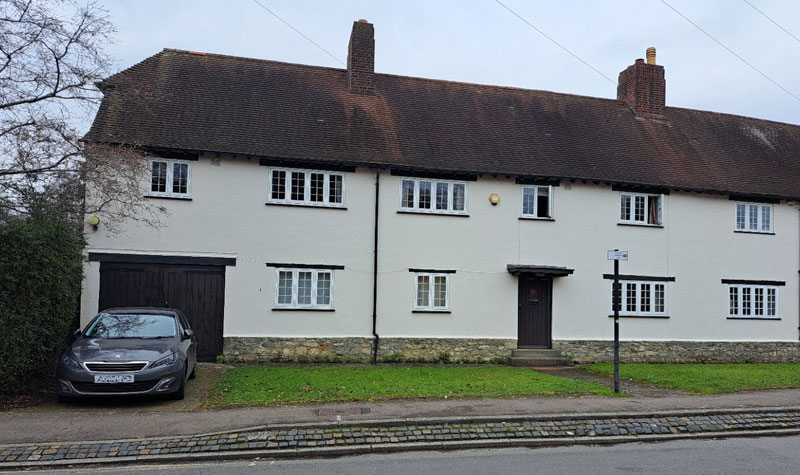
No. 33 across the road (one of the four houses that in 1940 replaced this row of cottages) has since 1977 been the new vicarage: