


John Holford Scott (1854–1918)
(Scott-Tucker 1891–1908 only)
John Holford Scott was born at Kirby Muxloe in Leicestershire near the end of 1854. He was the only son of the Revd John Haigh Scott, and his wife Anna Jane Holford Watts.
His father, who had obtained his B.A. in 1849 at New Inn Hall and his M.A. in 1851 at Wadham College in Oxford, had been appointed to the curacy of Kirby Muxloe and Braunstone in March 1853. By the time of the 1861 census he had been appointed Chaplain of the Liverpool Workhouse, and John (6) was living at 26 Canterbury Street, Liverpool with his parents and his sisters Louisa, Mary, Constance, and Lilla, plus their two servants.
John's father was Vicar of Frosterley, Durham from 1866 to 1873, and of Whiston, Lancashire from 1873.
On 25 October 1875 John Holford Scott (20) was matriculated at the University of Oxford by St Mary Hall, but did not obtain his BA until 1883, when he was 28.
At the time of the 1881 census (which was two years before he obtained his BA), Scott (26) was an assistant schoolmaster at a small school (for about 15 boys aged from 9 to 13) at 10 & 11 Louisa Terrace in Littleham, North Devon.
In the second quarter of 1884 in the Kingsbridge registration district of Devon, John Holford Scott married his first wife Margaret Tucker (born at Slapton in Devon in 1852/3, the daughter of the surgeon Richard Paige Tucker).
Scott was appointed Deacon at Falmouth in Cornwall in 1883 and Priest in 1885, and their first two children were born in Falmouth:
- John Richard Lewis Holford Scott in 1885
- Margaret Annie Bertha Madeline Scott in 1886.
Scott was elected Oxford Diocesan Secretary of the Church of England Temperance Society (CETS) with effect from 15 October 1886, and the family moved to 83 Wellington Square, Oxford, where the society was based. Scott spoke at meetings all over Oxfordshire, and the following report was published in Jackson’s Oxford Journal on 10 December 1887 about a meeting at Steeple Barton:
The Diocesan Secretary (the Rev. J. Holford Scott) followed with a stirring speech on the terrible evils of intemperance, and the duty of combating it by example, with energy and perseverance. He concluded by appealing to all temperance advocates to show united and determined action in the matter of the Sunday closing of public-houses and clubs of all kinds.
While Scott was living at Wellington Square in Oxford, his third child was born:
- Duncan Grant Haigh Holford Scott, was born in 1887.
Around this time Scott was very ill, and unable to preach or speak for nearly five months.
In May 1889 Scott was appointed Vicar of Headington and Chaplain of the Headington Union by Martha Ann Cubbidge Rawlinson, née Crundwell, who was the patron of St Andrew's from 1879 to 1927 and had lived at Headington Lodge prior to her wedding at that church in 1876 to the printer Ralph Rawlinson.)

The family came to live in the vicarage, which was then St Andrew’s House (right) on the corner of Osler Road.
Their fourth child was born at this house:
- Harold Beaver Holford Scott, born on 26 November 1889 and baptised at St Andrew’s Church a month later.
Jackson’s Oxford Journal records Scott’s achievements at Headington Horticultural, Poultry, Pigeon, Cage Bird, Rabbit, Cat, & Dog Show: in 1890 he won second prize for his fruit, and his cat was highly commended; and in 1891 he won second prize for three plants.
The new Vicar worked hard for Headington. Right away in 1889 he was in correspondence with the Local Board, promising that he would “never rest until some solution is found to the all-important problem of ‘How to drain and pave New Headington’.”
The 1891 census shows John and Margaret Scott living in St Andrew’s House with their four children (aged 1, 3, 4, and 5) and two nurses and a cook.
In the middle of 1891 John Holford Scott and his wife Mrs Margaret Scott both changed their surname by deed poll to Tucker (his wife’s maiden name), and henceforth were known as John Holford Scott Tucker and Margaret Scott Tucker (although more often than not Scott-Tucker was hyphenated in print). Their four children also took the surname Tucker.
In 1892 his father John Haigh Scott died in Prescot, Lancashire at the age of 67.
In 1892 John Holford Scott Tucker, as he now styled himself, was instrumental in founding the Headington Young Women’s Social Union, and the Headington branch of the Church of England Temperance Society grew greatly in strength during his incumbency.
In 1893 Scott-Tucker, together with the local doctor Robert Hitchings, founded Headington United Cricket Club, and when the cricket season was over the same autumn, they started up Headington United Football Club. Scott-Tucker played for both the cricket and the football clubs, and at the age of 39 managed to score the first two goals when Headington beat Victoria on 13 January 1894.
Scott-Tucker also worked hard as the Chairman of the committee that raised the funds needed to build in 1894 the new Headington National Schools (now the right-hand part of St Andrew’s Primary School).
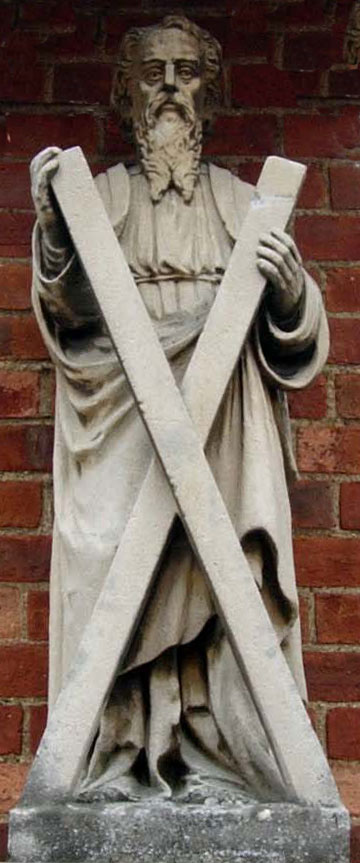
His wife Margaret also played her part: in August 1894 she had a stall in the marquee at the Horticultural Show in order to raise money for home missions and the new schools, and she also organized a collection to pay for the statue of St Andrew (right) that was placed over the front door of the new school (now moved to the back of the school).
Scott-Tucker had extracted a pledge from Miss Isabella Watson-Taylor of Headington Manor House to give £400 towards the new Headington National Schools, but she died before handing the money over. He brought an action against her executors in the High Court of Justice (Queen’s Bench Division) but lost his case, as the following report from Jackson’s Oxford Journal of 7 August 1897 shows:

In 1897 and 1898 Tucker made an unwise investment in 2,000 shares on the Stock Exchange, and lost most of his money.
Tucker’s personal downfall began three years after the Kingscote family moved to Bury Knowle House in 1894, when he was aged 40. Although he only had an income of £300 a year (with a house), in 1895 he agreed, along with George Moore, Vicar of Cowley, to stand surety for Adeline Georgiana Isabella Kingscote, a novelist who wrote under the pen-name Lucas Cleeve and the wife of his churchwarden Colonel Howard Kingscote of Cowley Barracks.
In December 1898 another hapless man, Lord Byron (a collateral descendant of the poet of that name) was ensnared by Mrs Kingscote, with the two vicars providing a reassuring presence at a meeting in Bury Knowle House. Byron advanced securities to Mrs Kingscote solely on the strength of the securities of the two vicars. Scott-Tucker was later to allege that Mrs Kingscote told him that “the Colonel and her children would be ruined unless he saved them”.
On Sunday 26 February 1899, Scott-Tucker accompanied Mrs Kingscote to Cheltenham to arrange for more money from Lord Byron (who advanced her £50,373 in all). As reported in The Times, the Official Receiver was later to state that Scott-Tucker had been drinking champagne and smoking cigars at the Queen’s Hotel there that Sunday; but in court in Oxford the question “Had you attended divine service in the church that day?” was disallowed. (Ironically, less than two years before, Scott-Tucker had written in the Headington Parish Magazine, “There is no greater hindrance to religion than intemperance”….) Another question disallowed in court was “Are you still officiating at the church?”
Despite his troubles, on 22 April 1899 Scott-Tucker attended Headington United Football Club dinner at the Britannia Inn and was described in the report about it in Jackson's Oxford Journal of 29 April as “the popular president of the club”. He acted as chairman, and said that “owing to ill-health he had been unable to take the interest he otherwise would in the game”, but that his wife “had shown the keenest interest in football, and it was entirely owing to her that they had a junior team of choir boys”.
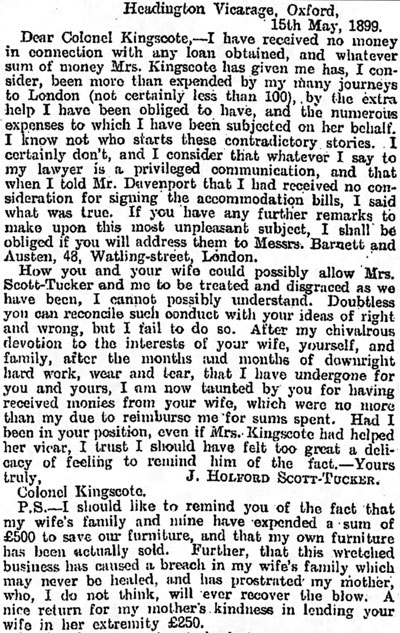
On 15 May 1899 Scott-Tucker wrote the following letter to Colonel Kingscote, which was given as evidence in court:
Jackson's Oxford Journal stated that one thing must be said in Mr Scott-Tucker's favour, that he did not appear to have dragged in anyone else.
On 15 May 1899 Scott-Tucker wrote the following letter, later produced in court, to Colonel Kingscote:

When later in 1899 Mrs Kingscote went bankrupt, she immediately fled to Switzerland, leaving the men to face the music. When summoned before the Official Receiver, The Times reports that Scott-Tucker said that
he did not derive any benefit, pecuniary or otherwise, from lending his name and assistance to Mrs Kingscote. What he did was out of kindness and to help her in her difficulties. She was not related to him in any way, but was one of his parishioners.
There was obviously a suspicion that he had received favours for his money, but to the remark in court: “I cannot help noticing upon what terms she addresses you”, he replied simply, “She addressed everyone in those terms.” He also said: “I believed in Mrs Kingscote from the very first to the very last” and “I was told over and over again that I would never lose a farthing.”
The Bishop of Oxford suggested that Scott-Tucker should resign his living in Headington, which he had held for ten years, and by the start of June 1899 St Andrew’s Church had a new vicar, Robert Walter Townson, who was himself to leave after a scandal. Four hundred of Scott-Tucker’s parishioners signed a letter of condolence and farewell and hope for his future.
The following appeared in The Times of 19 June 1899:
A Clergyman’s Failure.—A receiving order has been made against the Rev. John Holford Scott-Tucker, vicar of Headington, near Oxford. The gross liabilities are estimated to amount to £20,390 9s. 11d., and those expected to rank are £19,845 0s. 7d. The assets are estimated to produce £346 10s. 8d., leaving a deficiency of £19,498 9s. 11d. The debtor states the causes of his insolvency to be signing accommodation bills for Mrs. Howard Kingscote, of Headington, for which he has received no benefit at all. The larger creditors are also creditors in the bankruptcies of Lord Byron and the Rev. George Moore. The debtor has been called upon to submit an account of his Stock Exchange transactions, a cash account, and an account of his bill transactions since January 1, 1898.
On 20 June 1899 the bankruptcy of “John Holford Scott Tucker, Headington, near Oxford, clerk in holy orders” was announced in the Edinburgh Gazette.
On 16 September 1899 Jackson's Oxford Journal quoted the following address of regret and sympathy from 488 of his parishioners:
Reverend and Dear Sir,—We, the undersigned 48 adult parishioners of Headington, having heard that you are about to leave the parish, wish to convey to you our deep regret, and the assurance of our heartfelt sympathy in the great trouble which has brought this about.
We take this opportunity of expressing both to yourself and Mrs. Scott-Tucker our very sincere gratitude for the many acts of kindness, the ever ready sympathy, alike in our joys as in our sorrows, and the never failing help in times of sickness and trouble, that we have received at your hands; also our appreciation of the great interest you have taken in the various parochial institutions and in the welfare of the parish generally, during the 10 years you have been vicar of Headington.
We must not say “Farewell” without heartily wishing that wherever you may go, and whatever work you may be engaged in, God's blessing will attend you, and that you and yours may have a bright and happy future.
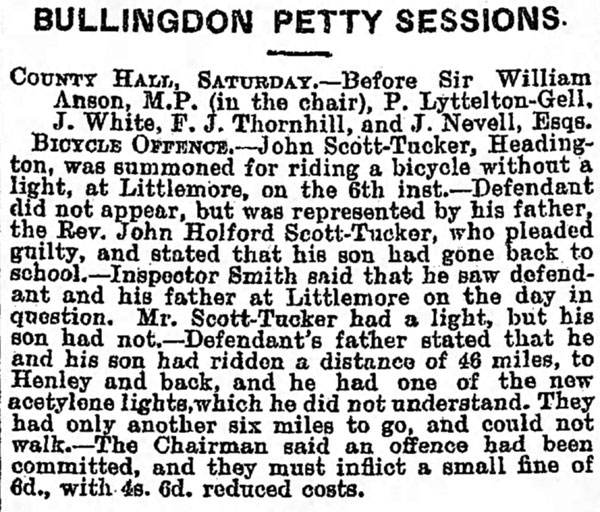
Scott-Tucker’s next appearance in court was at Bullingdon Petty Sessions for a more trivial offence, when after cycling to Henley and back with his twelve-year-old son John, he was unable to operate his son's bike light and were caught at Littlemore. It was reported in Jackson’s Oxford Journal of 30 September 1899:
At Oxford Crown Court in February 1900 it was said in Scott-Tucker’s defence that he had been “misled by the misrepresentations of this lady”; but the Judge’s opinion was that the mischief had been occasioned by the late Vicar of Headington “embarking upon this extraordinary career of infatuation”, and his application to be discharged from bankruptcy was refused.
The following letter from Mrs Scott-Tucker appeared in Jackson’s Oxford Journal on 10 February 1900, and shows that the family were still living in Headington at “The Cottage”:

Around this time, the former Vicar of Headington was penning the words and music for a new patriotic song: Jackson’s Oxford Journal of 3 March 1900 reported:

Scott-Tucker remained Chaplain of the Headington Union Workhouse until 1901, and at the time of the census that year was living with his wife Margaret at 53 Divinity Road in Oxford. Of their four children, only their eldest, John, a scholar of 15, was at home, and they had just one young servant girl. His other three children – Margaret (14), Duncan (13), and Harold (11) – spent the census night of 1901 at 1 St James’s Cemetery, Liverpool with their father's sister Constance Winter (née Scott) and her husband the Revd Richard Frederick Winter (48).
His wife Margaret Scott-Tucker (49) died at Bromborough near Birkenhead in Cheshire on 18 October 1901. Her permanent address was given as 53 Divinity Road, Oxford, and her executor was her husband's brother-in-law, the Revd Winter. Her effects came to £136 15s. 5d.
At the end of 1901 Scott-Tucker, now aged 46, moved to South Africa, where he served as Acting Chaplain to the Forces from 1901 to 1903, Priest-in-charge of Rustenburg in 1903/4, Rector of Transvaal in 1903/4, and Curate of St Albans in Pretoria in 1904/5.
Scott-Tucker then returned to England, and in 1906 he was appointed Curate of St John the Evangelist in Westminster (a church destroyed in 1941).
He evidently wished to start his new life back in England with a new name: on 29 February 1908 it was announced in The Times that he had changed his surname back from Scott-Tucker (showing that he had adopted the hyphen) to Scott (which had been his surname until 1891). He was then living at 46A Marsham Street, Westminster. Two months later on 23 April 1908 at St John the Evangelist Church in Westminster, John Holford Scott (as he now was), aged 53, married his second wife, Miss Marian Louise Cureton (44) of 26 Eccleston Street, Eaton Square. She was baptised at Westminster Abbey on 19 May 1864, and her deceased father William Cureton had been Rector of St Margaret's Westminster and a Canon of Westminster.
In 1908 he was appointed Vicar of Wilburton in Ely, Cambridgeshire.
John's mother Anna Jane Holford Scott died at Portsmouth at the age of 85 near the beginning of 1909.
At the time of the 1911 census Scott and his wife were living at Wilburton Vicarage with two servants.
John Holford Scott died there on 8 January 1918 at the age of 63. His death announcement in The Times two days later read:
SCOTT.—On the 8th Jan., at Wilburton Vicarage, John Holford Scott, for nearly 10 years Vicar of the parish, aged 63.
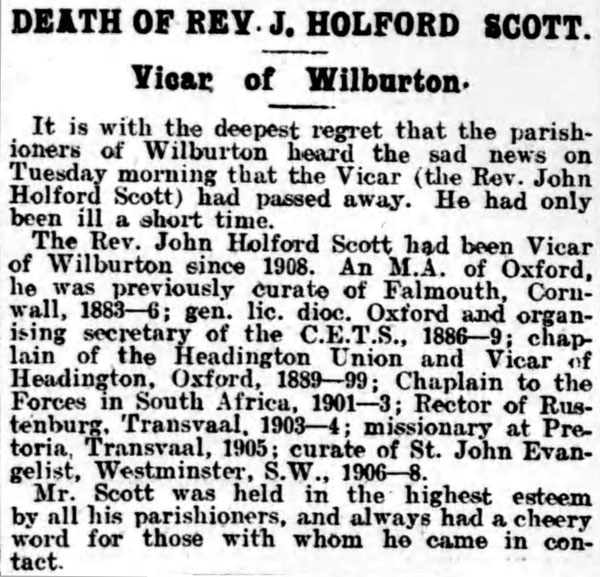
This short obituary in the Cambridge Weekly News of 11 January 1918 shows that he was held in esteem once again:
His effects came to £187 16s. 6d., and his executor was his eldest son Captain John Lewis Holford Scott-Tucker.
His second wife Marian Louise Scott died at 15 Fitzwilliam Street, Cambridge on 1 February 1937. Her effects came to £9,041 2s. 6d.
Jackson’s Oxford Journal
The sensational case of the novelist and the vicar was reported week after week in Jackson’s Oxford Journal. See especially the edition of 22 July 1899 (pp. 8f–g, 9a–g) under the main heading “Bankruptcy of the Vicars of Cowley and Headington”, which gives a full transcript under the subheading “Examination of the Rev. Scott-Tucker”. The latter examination was adjourned, and the transcript resumes in the edition of 29 July 1899, p. 5.
John Holford Scott’s children by his first wife
All four children kept the surname of Scott-Tucker.
- John Richard Lewis Holford Scott-Tucker (born 1885) went up to University College, Oxford in 1904. In 1908 he was gazetted from the Unattached List for Auxiliary Forces (University Candidate) to be Second Lieutenant in the Gloucestershire Regiment. He was then gazetted to Corporal, Adjutant, and Brevet Major. In the First World War he was appointed Deputy Assistant General of the General Headquarters in France, and was mentioned in dispatches in 1917 and 1918, winning the Croix de Guerre. In 1919 at Cockermouth he married Ida Beatrice Sutton, the younger daughter of Canon A. Sutton of Bridekirk Vicarage, Cumberland. They retired to Stoke Fleming on Dartmoor in the 1930s. He was living at Bowden House in Stoke Fleming when he died at Dartmouth & Kingswear Hospital on 24 July 1964. His effects came to £112,471, and his brother Duncan was one of his executors. His wife Ida died near the beginning of 1966. An Order of service of thanksgiving for his life is held by Devon Archives (1342A - 1/PZ 60)
- Margaret Annie Bertha Madeline Scott-Tucker (born 1886) never married. She was living at 22 Station Road, Budleigh Salterton, Devon when she died at Cranford Nursing Home in Exmouth on 13 November 1966 at the age of 80. Her effects came to £8,154, and her brother Duncan was her executor.
- Duncan Grant Haigh Holford Scott-Tucker (born 1887) joined the army, and transferred from The King's (Liverpool Regiment) to the Indian Army in September 1908. He died at Upper Flat, Seacroft, 22 Station Road, Budleigh Salterton, Devon at the age of 80 on 5 April 1968. His effects came to £13,584.
- Harold Beaver Holford Scott-Tucker (born 1889) served as a Second Lieutenant in The King's (Liverpool) Regiment and then as a Lance-Corporal in the Royal Fusiliers in the First World War. He emigrated to the USA in November 1919, and worked as a cotton buyer. He married Emily Catherine (surname unknown) on 19 January 1933: she was born in Missouri on 2 February 1889, and they had no children. He died in Arkansas in December 1963.
