


Mrs Adeline Kingscote, née Wolff (“Lucas Cleeve”) (1860–1908)

Mrs Howard Kingscote, née Adeline Georgiana Isabella Wolff, was a novelist who used the pen-name “Lucas Cleeve”. She lived at Bury Knowle House in Headington from 1897 to 1899 with her husband Colonel Kingscote, the Commander of Cowley Barracks, and their three children. Although she only lived there for two years, she left a trail of devastation in her wake that included the ruin and resignation of the Vicar of St Andrew’s Church, and at the same time managed to churn out her first four novels..
The drawing on he right, entitled “Mrs Kingscote”, was published in The Manchester News in Kansas, USA on 29 August 1901 in a two-column article entitled “A Daring Woman. Peculiar power of a daring English Society leader”, where she is described as
“a woman of depraved morals whose possession of an
influence beyond the ken of western intellects makes
her a dangerous factor in the affairs of mankind, and
one who should be shunned by society of all classes”
Mrs Kingscote was the daughter of Sir Henry Drummond Charles Wolff and Adeline Douglas, who were both living in Florence when they were married in the Consul’s office at Leghorn 1853. The unusual background of both her parents helps to explain her character.
Background of Mrs Kingscote’s father
|
Background of Mrs Kingscote’s mother
|
The childhood of Mrs Kingscote (Adeline Georgiana Isabella Woolf)
In 1853 Henry Drummond Charles Wolff brought his new wife Adeline back to London when he returned to work at the Foreign Office as private secretary of Lord Malmesbury, the Conservative foreign secretary. Their first child, Horace Henry Drummond-Wolff, was born in London in 1858.
In October 1858 Wolff became the private secretary of Sir Edward Bulwer Lytton, the colonial secretary. In June 1859 he went to Corfu to work as Secretary to Sir Henry Storks, the high commissioner of the Ionian Islands, taking his wife and baby son Horace with him.
Their daughter Adeline Georgiana Isabella Wolff (the future Mrs Kingscote) was born in Corfu on 16 November 1860. She was known by her middle name Georgiana, probably to distinguish her from her mother, who was also called Adeline. In 1864 Georgiana's younger brother Cecil James Drummond Wolff was also born in Corfu, and in that same year her father was created KCMG for his work in transferring the Ionian islands to Greece.
In 1868 Sir Henry had a house called “Boscombe Towers” built for his family in Hampshire, and the 1871 census shows Georgiana (10) living in that house with her mother and her brothers Horace (13) and Cecil (7), plus with six servants, including a page.
Sir Henry became MP for Christchurch in 1874.
At the end of 1877 Georgiana (17) was examined in London and passed the Senior Local Examination of the University’s Delegacy of Local Examinations, which made her an Associate in Arts. (The “AA Oxford Univ” she later included in her Who’s Who entry probably led to the common misapprehension that she had been an Oxford undergraduate.) She was placed in the third (and last) division of successful candidates, satisfying the examiners in the “Rudiments of Faith and Religion” and achieving a place in the second division in several sections. Languages were her forte, and in the sectional lists she was placed sixth out of all senior candidates who sat the examinations in German.
Georgiana’s father Sir Henry Drummond Wolff became MP for Portsmouth in 1880.
At the time of the 1881 census Georgiana’s father was paying a visit to retired lawyer John Beavan (87) in Tormoham (Torquay) and the only member of his family at home in Boscombe Tower was his wife Adeline, whose cousin, Miss Louisa Beauclerk (37) was staying with her. Neither Georgiana nor her brothers Horace and Cecil appear to have been in the country.
Mrs Kingscote’s marriage and children
On 25 June 1885, when she was 24, Adeline Georgiana Isabella Wolff was married by special licence at St Paul’s Church, Knightsbridge to Howard Kingscote (born on 29 April 1845 and then a 40-year-old Major in the Oxfordshire Light Infantry). The Bishop of Winchester officiated, assisted by the Revd Canon Nisbet and the Revd. W. Matthew Thomas, the Vicar of Boscombe. The occasion was described in the Pall Mall Gazette of 26 June as a “Primrose” wedding, as Adeline’s father had been one of the founders of the Primrose League, and all nine bridesmaids were Dames of the organization. Guests included the Prince & Princess Edward of Saxe-Weimar, the Marquis & Marchioness of Salisbury, the Count and Countess Marie Munster, Lord & Lady Randolph Churchill, the Russian and Turkish Ambassadors, and the Italian, Persian, Portuguese, Netherlands, and Danish Ministers.
Following their marriage, the couple went to India with the army, and their three children were born there in quick succession:
- Iris Adeline Harriett Augusta Kingscote (born on 5 August 1886 at Mysore, Bangalore)
- Henry Robert Fitzhardinge Kingscote (born on 1 October 1887 and Bangalore and christened at Tamil Nadu on 26 October 1887)
- Algernon Robert Fitzhardinge Kingscote (born on 3 December 1888 at Tamil Nadu, Bangalore).
On 20 May 1889 Howard Kingscote was promoted to a Colonel. The photograph below shows him sitting in the centre of the officers of the 52nd Battalion of the Oxfordshire Light Infantry in that year:
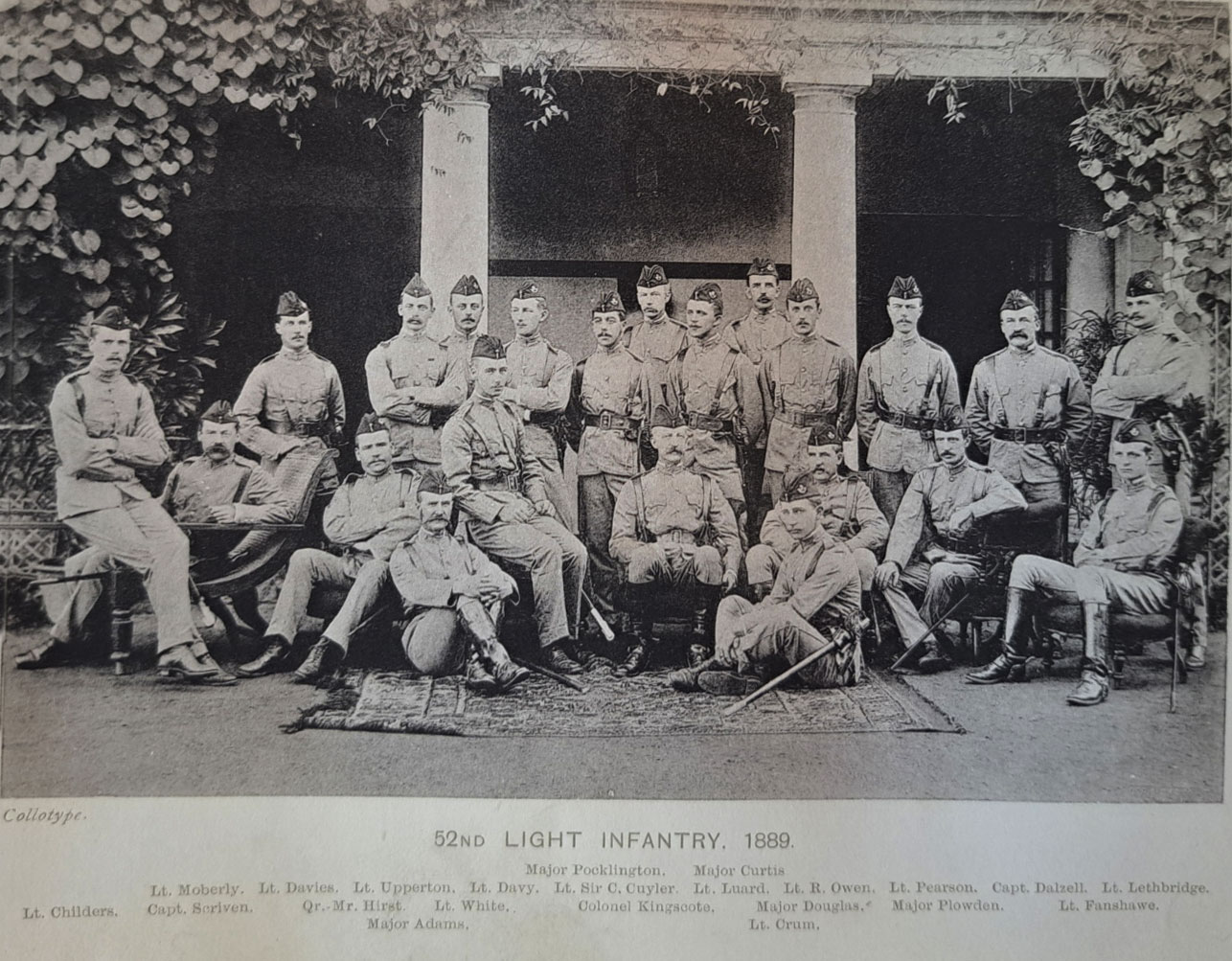
The Kingscotes returned to England in 1889/1890, and Mrs Kingscote's first book, Tales of the Sun or Folklore of Southern India, was published in 1890.
In July 1890 Colonel Kingscote was described as being "formerly of the Oxfordshire Light Infantry" when he was appointed Assistant Adjutant General of the South-Eastern District at Dover. Mrs Kingscote was presented to the Queen by Lady Emily Kingscote 5 March 1891, and shortly afterwards at the time of the 1891 census she was living at 12 Waterloo Crescent in Dover with her husband and their children Iris (4), Henry (3), and Algernon (2), plus six servants.
At the end of 1893 Colonel Kingscote was selected as Assistant Adjutant-General at the Horse Guards. In that year Mrs Kingscote's second book, The English Baby in India and How to Rear It, was published.
On 24 August 1895 Howard Kingscote was appointed Colonel of the Oxford Regimental District and Commander of Cowley Barracks.
They still spent the season in London, taking over the Dowager Countess of Warwick's House in Stable Yard, St James's Palace in May 1897. The Morning Post of 3 August 1897 announced that “Colonel and Mrs. Howard Kingscote have left Warwick House for Headington, near Oxford.” They moved into Bury Knowle House: they called it “The Beeches” (prior to this time it had no name).

It was while living at Bury Knowle House in Headington that Mrs Kingscote first turned to fiction, writing her first four novels there between 1895 and 1897 under the pen-name of Lucas Cleeve.
Her first novel, The Woman Who Wouldn’t (written in response to Grant Allen’s novel of 1895 called The Woman Who Did) received a bad review in The Times of 28 September 1895: the reviewer wrote that it would not interest anyone but “here and there, a prurient schoolgirl”, and that “no person with a grain of humour could have written it”. Mrs Kingscote retorted that “If one young girl is kept from a loveless, mistaken marriage, if one frivolous nature is checked in her career of flirtation by remembrance of Lady Morris, I shall perhaps be forgiven by the public for raising my feeble voice in answer to the The Woman Who Did.” Notwithstanding the first bad review, the book sold out in three weeks, and “Lucas Cleeve” continued to write prolifically.
Mrs Kingscote was extraordinarily extravagant, and the following advertisements indicate that in 1896/7 the Kingscotes reduced the number of their staff at The Beeches (Bury Knowle House):
Jackson's Oxford Journal on 25 July 1896:
A LADY RECOMMENDS an excellent Middle-aged COOK, for London entirely if possible: wages £35 to £40; with kitchenmaid; parted with for no fault: disengaged August 12.—Ramsay, The Beeches, Old Headington, Oxford.
A LADY wishes to RECOMMEND a most respectable, middle-aged Woman, with no encumbrances, clean and energetic, as LODGEKEEPER or any Place of Trust: understands poultry, laundrywork, and dairy.—Address The Lodge, The Beeches, Old Headington, Oxford.
Morning Post, 22 July 1896:
COLONEL KINGSCOTE highly RECOMMENDS his COACHMAN; excellent driver, pair or single: understands hunters; six years' personal character, three previous; town or country; married; age 34; one boy three years....
Morning Post, 5 August 1896:
A LADY RECOMMENDS her French Schoolroom Maid as SCHOOLROOM MAID or CHILDREN'S MAID or NURSE to walking children: disengaged September 1. Eugénie, The Beeches, Old Headington, Oxford.
Morning Post, 3 February 1897:
COLONEL KINGSCOTE RECOMMENDS highly a first-rate Groom as SECOND or THIRD COACHMAN, or Head groom of two; parted with for no fault; long character; good rider and driver; age 21; for temporary or permanent place; smart appearance, clean; weight 9st.; height ft. 7in.—Near Old Headington, Oxford.
At the same time, however, Mrs Kingscote advertised for new staff at her Headington home:
Morning Post, 20 August 1896:
REQUIRED, for the country, September 1, a Good PLAIN COOK; early riser; kitchenmaid and assistance; wages about £35; dairy and baking; a French-Swiss MAID for lady and little girl aged 10; must be first-rate hairdresser and dressmaker; wages £30 to £35; and FOOTMAN under butler; odd man half day; height 5ft 10½in; characters must be long and personal; lady's recommendations preferred.—The Beeches, Headington, Oxford.
The scandal
Mrs Kingscote became notorious in Oxford for her charm and her extravagance, captivating (and often eventually bankrupting) the men who kept her financially afloat. First there was a Liverpool money-lender who lent her a large amount on the strength of her promise to introduce his daughter to “everybody who mattered” in the south of France, followed by an estate agent whom she duped into lending her £500 after getting him to value a country estate that (unbeknownst to him) was not even hers.
In 1897 she borrowed money from the Revd George Moore, the Vicar of Cowley (a man usually known for settling disputes with his fists), who was also Chaplain of Cowley Barracks and so knew Colonel Kingscote well. From 1898 Mrs Kingscote used him to find people to lend her money. When Moore appeared in the Bankruptcy Court in June 1899, it was reported that he said he was:
a person who went round for a commission to various people to induce them to lend money. All these transactions did not give him any insight into Mrs. Kingscote's financial condition; she had a clever way of getting money.”
One of these people who came up to Bury Knowle House to arrange to lend money to Mrs Kingscote and was bankrupted as a result was Lord Byron, (a collateral descendant of the poet of that name) and he was eventually owed over £21,971, despite having received a letter from the Revd Moore on 20 October 1898 stating:
I understand from Mrs. Kingscote that you are kindly helping her temporarily, and I write to say I will be responsible for any advances you make to Mrs. Kingscote, and I will replay them when the loan she has mentioned to you is complete.
In April 1898 Mrs Kingscote approached the Revd Scott-Tucker, the Vicar of St Andrew's Church in Headington where her husband acted as Churchwarden, and he made over a hundred journeys to London on her behalf. He also lent her money himself and was bankrupted as a result.
In 1898 the 18-year-old solicitor’s clerk Frank Gray (later MP for Oxford) had to go up to Bury Knowle House (The Beeches) to serve writs on Mrs Kingscote, and described her as “the finest adventuress I ever met”, adding, “I thought this woman with the consuming brown eyes was the most wonderful thing on earth.”
Mrs Kingscote went bankrupt to the tune of £100,000 (then a tremendous sum), bringing the Vicar of Headington and of Cowley as well as Lord Byron and others who had lent her money down with her. She does not. however, appear to have been fazed by her disgrace or the prospect of losing all her possessions as a result of bankruptcy, as when the solicitor’s clerk Frank Gray paid his last visit to her, she copied out the words “Victoria by the Grace of God, Queen Defender of the Faith” from the writ he served on her and used them as the opening words of her next novel, What a woman will do (1900).
In June 1899 Lord Byron appeared at Chelmsford Bankruptcy Court and said that he had spoken to Colonel Kingscote several times about the loans he had made to his wife, and believed that about £3,000–£5,000 of the £50,373 he had lent to her had been spent in furnishing The Beeches (Bury Knowle House). He believed that Mrs Kingscote was now in Switzerland.
The sensational court case was reported in great detail week after week in Jackson’s Oxford Journal, and also made the national press:
- Jackson’s Oxford Journal, 29 April 1899: “Lord Byron’s financial affairs”
- The Times, 4 May 1899: “The affairs of Lord Byron”
- Jackson’s Oxford Journal, 6 May 1899: “The affairs of Lord Byron: £50,000 advanced to Mrs Kingscote”
- Jackson’s Oxford Journal, 27 May 1899: “Failure of the Vicar of Cowley”
- Jackson’s Oxford Journal, 10 June 1899: (1) “Lord Byron’s bankruptcy” and (2) “Vicar of Cowley in the Bankruptcy Court”
- The Times, 29 June 1899: “A Clergyman’s Failure”
- Jackson’s Oxford Journal, 1 July 1899: “Local Bankruptcy Cases: John Holford Scott”
- Jackson’s Oxford Journal, 8 July 1899: (1) “The Bankruptcy of the Vicar of Headington” and (2) “The affair of Lord Byron”
- Jackson’s Oxford Journal, 22 July 1899: (1) “A local cause celebre” and (2) “Bankruptcy of the Vicars of Cowley and Headington: The Kingscote loans: Extraordinary disclosures: Threats of criminal proceedings”
- Jackson’s Oxford Journal, 29 July 1899: “Bankruptcy of the Vicars of Cowley and Headington: Adjourned examination: Further disclosures; The bankruptcy of Lord Byron: Where is Mrs Kingscote?”
- Jackson’s Oxford Journal, 5 August 1899: “Lord Byron’s failure: Mrs Kingscote’s extraordinary letters”
- Jackson’s Oxford Journal, 12 August 1899: “Mrs Howard Kingscote as a match maker: Sequel to an extraordinary wedding”
- The Times, 3 August 1899: “The bankruptcy of Lord Byron”
- Jackson’s Oxford Journal, 26 August 1899: “Oxford Bankruptcy Court: Vicar of Headington’s failure; Revd George Moore’s bankruptcy”
- Jackson’s Oxford Journal, 7 October 1899: (1) “Bullingdon Petty Sessions: The Vicar of Cowley & a Manchester accountant: Serious charge dismissed” ; (2) “Oxford Bankruptcy Court: The failure of the Rev. Scott-Tucker” and (3) “Lord Byron’s failure”
- The Times, 12 October 1899: “The affairs of Lord Byron”
- Jackson’s Oxford Journal, 2 December 1899: “Mrs Kingscote’s financial transactions”
- Jackson’s Oxford Journal, 9 December 1899: “Mrs Kingscote’s financial transactions”
- Jackson’s Oxford Journal, 10 February 1900: “The bankruptcy of the Rev. J. H. Scott-Tucker: Order for discharge refused”
- Jackson’s Oxford Journal, 21 July 1900: “Mrs Kingscote’s financial transactions: A husband’s liability”
- Jackson’s Oxford Journal, 27 October 1900: “The bankruptcy of the Rev. George Moore”
While the case against Mrs Kingscote was taking place, Jackson’s Oxford Journal reported on a smaller case heard on 11 May 1899 at the Oxford County Court at County Hall. The Plaintiff, William John Mayo, who was a tobacconist at 42 Cornmarket Street, said that Mrs Kingscote’s butler had brought him a cheque for £10 which bounced, and that she also owed 15s. for goods that had been delivered. The Judge came out in Mayo’s favour.
Sale of contents of Bury Knowle House
The contents of The Beeches (Bury Knowle House had to go under the hammer in June 1899. It was a very large house, as it already included the rear wing (added by the previous owners, the Fieldens), and the auction of its contents took place on the premises over four days by J. R. Mallam & Son. The sale catalogue provides a snapshot of life in a Headington mansion during the last century: everything in the house that belonged to the Kingscotes is itemized, from the chandelier in the dining room to the slop-pails in the housemaid’s closet, and from the Moët et Chandon champagne in the cellar to the last heap of manure in the yard. The sale raised about £2,000.
The house itself was then sold.
Mrs Kingscote in Switzerland, and her death
On 9 September 1899 the following appeared in Jackson’s Oxford Journal:
Retirement of Colonel Kingscote.—It is reported that Colonel H. Kingscote, commanding the 43rd (Oxfordshire Light Infantry) Regimental District is about to retire on half-pay. This officer was wounded in the Bhootan campaign of the ’sixties, and received the medal with clasp.
Howard Kingscote was separated from his wife but did not divorce her, and she continued to list him as her husband in Who’s Who right up to her death. Her daughter went to live with her in Switzerland and her two sons were sent to boarding school in Germany. Her husband and sons do not appear to have been in England at the time of the 1901 census.
Mrs Kingscote spent the rest of her life in Switzerland, and remained irrepressible. It must have been in about 1901 that she met the American Joseph Hergesheimer, who was then 21, and (according to his obituary in The Times of 26 April 1954) inspired him to become a novelist. In her last entry in Who’s Who, she claimed that her education was at the “School for Scandal”; for her career she put “Chequered and varied career, great traveller and linguist”; and she recorded her recreations as “Riding, cycling”.
Her output in Switzerland increased to between five and eight books a year, bringing her total oeuvre to 65 books when she died at Château d’Œx on 13 September 1908 at the age of 48. She wrote so prolifically right up to the last moment that six of her books were not published until after her death.
Her obituary in The Times of 16 September 1908 read:
MRS. KINGSCOTE
The death occurred on Sunday, at Château d’Oex, Switzerland, of Mrs. Adeline Georgiana Isabel Kingscote, better known by her pen name of “Lucas Cleeve.” She was the daughter of Sir Henry Drummond Wolff and the wife of Colonel Howard Kingscote. She was a great traveller and linguist, and wrote some books of travel, but she will be chiefly remembered by her novels. Possessed of considerable facility of style and a vivid imagination, she appealed to a large body of readers, not, perhaps, the most critical. Nevertheless, her work had a certain power, though it was of singularly varying merit. Her best known works were “The Real Christian”, “Blue Lilies”, “Eileen”, “The Secret Church”, and “Her Father’s Soul”.
In The Love letters of a faithless wife, which was published after her death, Mrs Kingscote appears to reveal some of her own feelings. The fictitious wife, Hertha, is only 27, but feels so neglected by her husband, Captain Ralph Atherton, that she considers taking lovers; but in the end she does not succumb. Hertha felt that she “might do all that is worst in one way, but she would still be sublime in others”, and that there were two classes of husband: “The men who love again anywhere and everywhere, and who are unfaithful; and the men who, when they have married a wife, don’t want to love or be loved any more.” Hertha has the latter kind of husband, and asks:
“Why can I not be as other women are, content with a cold, unmeaning kiss, an occasional kindly word in the midst of how many angry ones; content to see the dear children at play, and to order the household, and inquire into the price of meat, and of groceries and of vegetables?”
Postscript: What became of Mrs Kingscote’s family?
Mrs Kingscote’s parents
Sir Henry Drummond Charles Wolff (1830–1908)
Sir Henry was British ambassador in Madrid from 1892 to October 1900, when he retired at the age of 70. He was living with his wife at 28 Cadogan Place, Chelsea at the time of the 1901 census. They then moved to 128 King’s Road, Brighton, where Sir Henry died on 11 October 1908, on the day before his 78th birthday and just one month after the death of his daughter.
Lady Wolff (Adeline “Douglas”) (1826/7–1916)
Lady Wolff was granted a civil-list pension in 1909 following the death of her husband. At the time of the 1911 census she was the head of the household at 6 Ashburnham Mansions, Chelsea. Her married son, Cecil Drummond Wolff (47), was with her, but not his wife, and they only had one servant. Lady Wolff died at her grace-and-favour apartment at Hampton Court on 31 March 1916, and her age in the death register is (for once) correctly given as 89.
Mrs Kingscote’s husband
Colonel Howard Kingscote (1845–1917)
Colonel Kingscote ceased to be Colonel of the Oxford Regimental District on 13 September 1899, and retired from the army altogether on 29 April 1902. Just a year after Adeline’s death, on 28 September 1909 at Summertown Church, Howard Kingscote, described as a retired colonel of 10 Eaton Terrace, London, married his second wife, Mrs Annie Glover (née Foster) of 160 Banbury Road, Oxford, and his and Adeline's son Henry was one of the witnesses.
At the time of the 1911 census Howard and Annie were living at The Elms in Iver, Buckinghamshire. Howard (65) was described as a retired army colonel, and his son Henry was living with them, while Annie (40) was accompanied by her fifteen-year-old daughter Violet. They had three servants. Colonel Kingscote died at the age of 71 on 17 March 1917 (death registered Eton district).
Mrs Kingscote’s three children and their families
(1) Iris Adeline Harriett Kingscote (1886–1970)
Iris, born on 5 August 1886, was nearly 13 in 1899 when she accompanied her mother on her flight to Switzerland.
On 15 February 1909 in London Iris married Cajus Maria Albrecht Michael Franz Graf von Praschma, the son of Friedrich Wilhelm Graf von Praschma and Elizabeth Helena Maria Therese zu Stolberg-Stolberg. They had four children:
- Friedrich Heinrich Justinus Falcon Cajus Graf von Praschma (born on 14 April 1910, died 28 July 1944)
- Sigismund Ludwig Karl Josef Melchior Graf von Praschma (born on 8 October 1912)
- Maria Monika Iris Hedwig Henriette Gräfin von Praschma (born on 4 May 1922)
- Peter Thedor Ignatius Maria Graf von Praschma (born on 31 July 1925, died 13 November 1991)
Iris Graf von Praschma née Kingscote died at the age of 83 on 8 June 1970 at Wollmarshofen, Germany.
(2) Henry Robert Fitzhardinge Kingscote (1887–1962)
Henry, born on 1 October 1887, was nearly 12 in 1899 when his mother fled the country. He went to school in Germany, and in 1911 he was staying with his father and stepmother in Buckinghamshire.
He worked as a clerk for the Canadian Pacific Railway Company, and was detained in Vienna in the First World War: there was a request from his father, Colonel Howard Kingscote of Iver, Buckinghamshire, for his release as unfit for military service.
On 5 December 1923 Henry married his stepsister Violet Wetherald Glover, and they had two daughters:
- Aldena Elizabeth Kingscote (born on 25 November 1924). She was married in the North-West Surrey registration district in the first quarter of 1950, but details are unclear.
- Daphne Anne Kingscote (born on 19 April 1928). She was married in the Newbury registration district in the third quarter of 1952, but details unclear.
Henry Robert Fitzhardinge Kingscote was living at Kintbury in Berkshire in 1952, and died in the Newbury district near the beginning of 1962..
(3) Algernon Robert Fitzhardinge Kingscote (1888–1964)
Algernon, born on 3 December 1888, was ten years old when his mother fled the country in 1899. He went to school in Germany, and at the time of the 1911 census he was a Second Lieutenant in the Royal Garrison Artillery living in barracks at Plympton, Devon. He fought in the First World War between 1914 and 1919, where he was mentioned in despatches three times: he gained the rank of Lieutenant-Colonel in the service of the Royal Artillery, and was decorated with the award of Military Cross.
Algernon was a tennis champion, and The Times of 18 February 1919 states that he learnt the game “on the picturesque courts of the Château d’Oex Club in Switzerland”, which suggests that he lived with his mother in exile. He won the men’s singles event at the Australasian Championships in 1919 and competed in the 1924 Summer Olympics in Paris, beating the Olympic record for tennis singles.
Right: cigarette card showing Algernon Kingscote. The text on the back reads:
29. A. R. F. Kingscote. Lt.-Col. Kingscote, M.C., was born in India, 1888, his mother being “Lucas Cleeve,” the novelist. He won the Championship of Switzerland, 1908. Made a name in lawn tennis before the War, and was a member of the British Davis Cup team which visited America in 1914. In 1919 Kingscote reached the final of the All-Comers’ singles at Wimbledon, and captained the British Davis Cup team which challenged Australia in Sydney. In 1920 won Australian Singles Championship, and also had a five set match with W. T. Tilden at Wimbledon. One of the soundest British players of the past ten years.
On 9 September 1919 Algernon married Marjorie Paton Hindley, and they had three children:
- Marjorie Faith Kingscote (born on 14 July 1920)
- Rachel Joy Kingscote (born on 16 May 1922)
- David Fitzhardinge Kingscote (born on 23 June 1925, died on 5 September 1945).
Algernon fought in the Second World War between 1940 and 1942.
Algernon Robert Fitzhardinge Kingscote died on 21 December 1964 (death registered North-West Surrey district).

Adeline’s two brothers and their families
(1) Horace Henry Drummond Wolff (1858–1889/90)
On 23 August 1887 at St Paul's Church, Wilton Place, London Horace Henry Drummond Wolff described as a retired army captain aged 30 living at 4 Chesham Street, married Mary Stephanie Claughton (31) of Warley, South Weald, Essex and the daughter of the deceased bishop Piers Calveley Claughton. They do not appear to have had any children, and Henry died less than three years after the wedding. His widow was living with two other widows (who between them had ten servants) at 24 Curzon Street, Mayfair at the time of the 1891 census.
(2) Cecil James Drummond Wolff (1864–1943)
Cecil James Drummond Wolff was a Private Secretary lodging at 27 Pall Mall at the time of the 1891 census.
In 1896 at Pau, he married Zaida Foster had the following children:
- Zaida Cecile Drummond Wolff (1896–1878)
Zaida was born on 27 October 1896. She married William John Montagu Watson-Armstrong, 2nd Baron Armstrong at Bushey, Hertfordshire on 27 October 1917. She died on 15 February 1978.
Her son, William Henry Cecil John Robin Watson-Armstrong, 3rd Baron Armstrong, was born on 6 March 1919 and died on 1 October 1987.- Henry Drummond-Wolff (1899–1982)
Henry was born on 16 July 1899. He was educated at Radley and Sandhurst, and served in the Royal Air Force in 1917. He married Margaret Fahnestock on Rhode Island in 1933, Henry was MP for Basingstoke in 1934/5 and wrote a number of books on the Commonwealth and the Common Market: see Who Was Who for his full career. He had just one child:
Georgiana Drummond-Wolff, born in London in 1934 (registered in Marylebone fourth quarter).At the time of the 1911 census Cecil was staying with his mother at 6 Ashburnham Mansions, Chelsea.
Cecil James Drummond Wolff died at Pender Harbour, British Columbia at the age of 79 on 13 April 1943.
Books by Mrs Kingscote The books in this list were written under the pen-name Lucas Cleeve unless otherwise indicated. |
|
1890 |
Tales of the sun; or Folklore of southern India* (collected by Mrs H. Kingscote and Pandit Natêsa Sástrî) |
1891 |
Article on “The decline of Indian taste. Contemporary English art” (Georgiana Kingscote) |
1893 |
The English baby in India, and how to rear it (Mrs H. Kingscote)* |
? |
Life of Eugenie Berni* In the Ricefields* |
1895 |
The woman who wouldn’t* |
1896 |
Lazarus. A tale of the earth’s great miracle* Epicures* |
1897 |
The Water Finder* |
1898 |
The Monks of the Holy Tear* |
1900 |
What a woman will do The world’s blackmail Yolande the Parisienne A dream of the twentieth century |
1901 |
What men call love Plato’s handmaiden* Mostly fools and a duchess As the twig is bent Mary Anne of Parchment Buildings The real Christian* |
1902 |
Woman and Moses Blue lilies* His Italian wife The magic of Rome The purple of the Orient |
1903 |
The man in the street The indiscretion of Gladys From Crown to Cross Eileen* Anglo-Americans Free soil, free soul |
1904 |
Our lady of beauty. Being the story of the love of Charles VII, King of France, and Agnes Sorelle, Demoiselle de Fromenteau* Lady Sylvia The children of endurance The fool killer |
1905 |
Mademoiselle Nellie Stolen waters Saint Elizabeth of London The dreamer* The progress of Priscilla |
1906 |
Soul twilight The secret church* Billy’s wife Love and the king Seven nights in a gondola The confessions of a climber Counsels of the night A double marriage |
1907 |
Selma* Her father’s soul* The mascotte of Park Lane The rose geranium* The confessions of a widow Nathan Todd. A story of modern Virginia Dollar city The fool’s tax |
1908 |
A woman’s aye and nay The love seekers (written as Mary Walpole) The Cardinal and Lady Susan What woman wills Duchinka An old man’s darling The hoverers |
1909 |
Bruised lilies The one moment The arbitrator |
1909 |
Lady Susan and not the Cardinal Rosabel. A story of the greater love Friends of fate |
1911 |
The love letters of a faithless wife |
Adeline Kingscote and her father and paternal grandfather have entries
in the Oxford Dictionary of National Biography
The ODNB online is available free to many public library users, including those in Oxfordshire:
put your library ticket number in the “Library Card Login” box
See also Teresa Crompton, The Life of Georgiana Kingscote, Novelist and Swindler (2024)
