


The Rookery (now part of Ruskin College)
List entry for The Rookery: 1369369
(See separate web pages for Rookery Walled Garden, the
Rookery School,
Stoke House, and The Finch family)
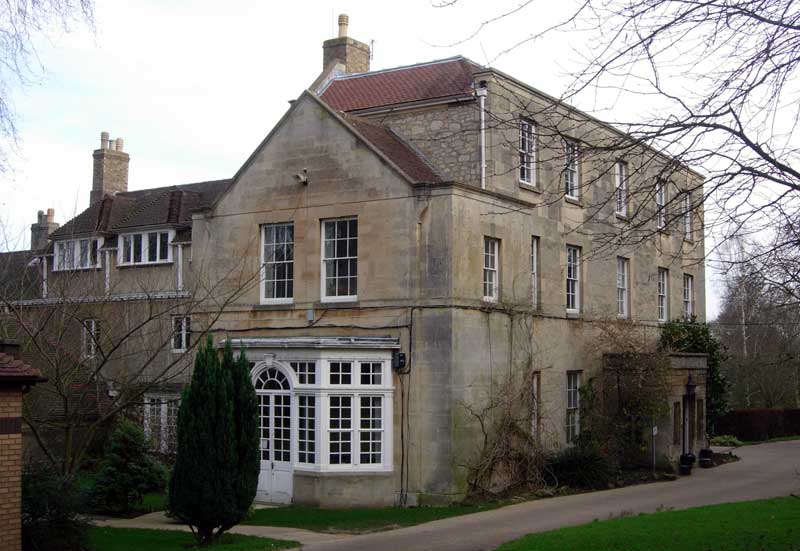
The Rookery is on the corner of Dunstan Road and Stoke Place in Old Headington. It was known as Charlton Lea from 1899 to 1933, and then reverted to its old name of the Rookery. It was renamed Ruskin Hall when it was bought by Ruskin College in 1946. In 2012 it became Ruskin College, following the building of a large new extension to the east and the closure of the old college building in Walton Street.
In or about 1660 William Finch (died 1697) converted a sixteenth-century dwelling previously in peasant occupation into a larger house that became known as the Rookery and it remained in the hands of his descendants until 1863. In the National Archives there is a 1674 terrier (ref. 567/99/1) relating to the lands belonging to William Finch of Headington among the documents of the Plymouth solicitors Shelly & Johns.
The central range of this three-storey house dates from the sixteenth and seventeenth centuries, but in 1810 there were extensive alterations as well as additions on the north and west sides, and further large-scale improvements in 1910. It is built of ashlar and rubble, and has a modern brown-tiled roof and yellow brick stacks. The south elevation (shown more clearly in the photograph below) has five nineteenth-century sash windows in plain stone reveals, a stone porch, and a moulded parapet. The north wing has a modern modillioned eaves cornice, three stone mullioned windows of three and 4 four lights, and a rubble gable end. The house was described thus by the Royal Commission on the Historical Monuments of England, published in 1939:
(274) The Rookery, house 250 yards N.W. of the church, is of three storeys; the walls are of rubble. The middle part of the house was built late in the 16th or early in the 17th century and there are extensive modern additions. There are some original three and four-light mullioned windows and two stone fireplaces with moulded jambs and four-centred arches in square heads.
To the E. of the house is an enclosure with stone walls [the walled garden with its crinkle-crankle wall]; the N. wall has three diagonal projections, lined on the S. or inside with brick and perhaps for fruit-growing Condition—Good.

Above: South elevation; below: West elevation: these two postcards date from around the late 1940s and are described as showing “The Rookery, Ruskin College, Oxford”.

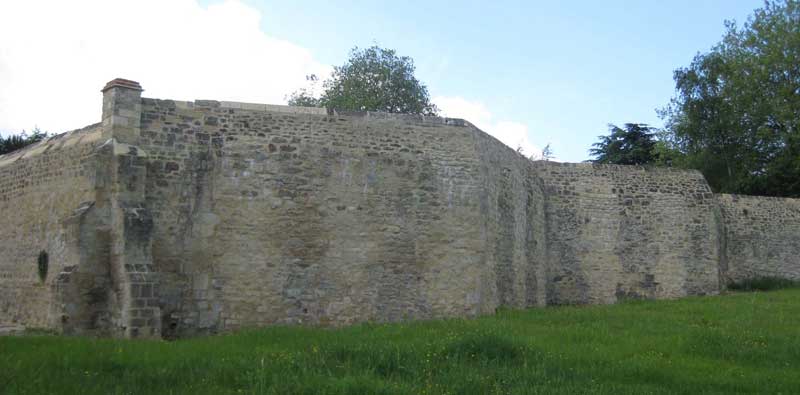 The crinkle-crankle wall of the Rookery’s walled garden, which dates from the eighteenth century
Nineteenth century
Under the Headington Enclosure Award of 1804 Richard Finch the younger was awarded over 30 acres in lieu of copyhold lands under Heddington Manor, while his widowed mother Mrs Letitia Finch was awarded 110 acres of land as a lessee of Magdalen College. These 140 acres included the site of the present house called Stoke on the other side of Stoke Place, and Highfield Farm on the other side of the London Road. Thus the lands of the Rookery stretched from north of the present northern bypass to as far south as Old Road.
Richard Finch partially rebuilt the Rookery in about 1810 He lived there with his wife, and his widowed mother Laetitia and his unmarried sister of the same name. On 11 July 1840 the following advertisement appeared in Jackson’s Oxford Journal:
To be LET, at Michaelmas next,—A pleasant COTTAGE RESIDENCE, situated in a Paddock of 4 Acres, at Headington, near Oxford, with a green-house attached, opening into one of the parlours; a coach-house, 3-stall stable, pigsties, cow shed, and fowl-house. A gentleman may be accommodated with 140 more Acres.—Enquire of Mr. Finch, Headington. (Jackson’s Oxford Journal, 11 July 1840)
it is hard to imagine the Rookery being described as a “cottage residence”, but the 140 acres of land matches exactly what he and his mother together had been granted under the Headington Enclosure Award.
He obviously failed to let the house, and tried again in 1849:
HEADINGTON, NEAR OXFORD,
Within half an hour’s drive of the Great Western Railway Station.
TO be LET, UNFURNISHED, for a term,—A neat comfortable RESIDENCE; consisting of two parlours (one opens into a green-house), two kitchens, a store room, and out-offices; three good bed rooms, and two smaller rooms, besides a servant’s room; a three-stall stable and coach-house, with about Three Acres and a half of good Grass Land, and a kitchen garden detached; it commands a beautiful view.—Immediate possession may be had.—Apply to Mr. Finch, Headington, near Oxford. (Jackson’s Oxford Journal, 17 February 1849)
On 10 April 1849 Richard Finch’s wife Clara died, and later that year Richard Finch decided to sell the home that had been in his family for nearly two hundred years:
HEADINGTON, NEAR OXFORD.
TO be sold—a neat FREEHOLD RESIDENCE, with stabling and coach-house, and 3½ Acres of Meadow Land, and a small kitchen garden.—Apply to Mr. Finch, Headington. (Jackson’s Oxford Journal, 10 November 1849)
The house did not sell, and so the Headington Rate-Book of December 1850 lists Richard Finch as the occupier as well as the owner of the Rookery: its rateable value was then £81 and its estimated extent two acres. It appears that the Finches moved out and let the premises very soon afterwards to Colonel Champaigne, as the April 1851 census shows Richard (then a widower of 71), and his sister Laetitia (a spinster of 70) lodging with one servant at Miss Hanwell’s school in Old High Street.
On 14 July 1851, Richard Finch made a will leaving all his rents to his sister Laetitia and empowering his trustees to sell his property after her death; and just ten days later, on 24 July 1851, he died at the age of 71, outliving his mother by only five years. His sister Laetitia did not enjoy the rents for long: she died two and a half years later at the age of 73 and was buried in St Andrew’s churchyard on 20 January 1854.
The Trustees of the Finch family continued to let out the house furnished between1854 and 1858, and Sturman Latimer lived there until early 1857. The following advertisement appeared in Jackson’s Oxford Journal on 14 March 1857:
HEADINGTON, NEAR OXFORD.
To be LET, from Lady Day next, — A genteel PRIVATE RESIDENCE, with a Close of PASTURE GROUND, containing about Five Acres; coach-house, stables, and piggeries, and a small kitchen garden, for many years the residence of the late Richard Finch, Esq., and lately occupied by Sturman Latimer, Esq., and his under-tenants. — For further particulars apply to Mr. A. G. Holmes, solicitor, Carfax, Oxford.
The Rookery was let out briefly to the Revd Dr Arnold from 1857. When he moved out the next year the Finches made an attempt to sell the house. The following advertisement appeared in Jackson’s Oxford Journal on 14 August 1858:
HEADINGTON, near OXFORD
THE MANSION HOUSE,
Called “THE ROOKERY,”With its Lawns, Pleasure Grounds, Gardens, and Orchards, now in the occupation of the Rev. Dr. Arnold, and formerly the residence of Richard Finch, Esq.
TO BE SOLD BY AUCTION,By I. and W. FISHER,
At the Star Hotel, Oxford, on Thursday the 2nd day of September, 1858, at Two o’clock (by order of the Executors of the said Richard Finch, Esq.).The Mansion is substantially built, and contains spacious entrance hall and staircase, handsome dining and drawing rooms, six principal bed chambers, two good dressing rooms, abundant servants’ offices and sleeping chambers, capital arched cellars, and a laundry and brew-house. The Out-offices comprise stabling for five horses, coach-house, a small cow-house, and other out-buildings. The whole surrounded by Pleasure Grounds, comprising shrubberies, lawns, kitchen and fruit gardens, rookery and orchard, and Close of Grass Land, embellished with stately firs, elms, and other trees, and containing together nearly 8 Acres.
The Mansion House and Grounds are Copyhold of Inheritance of the Manor of Headington, and considered to be nearly equal in value to Freehold. The Stables and Coach-house and front part of the Lawn are held by Lease from New College, Oxford, for a Term of 20 years, from Old Michaelmas, 1852.
Particulars, with a lithographic plan, and cards to view, may be obtained on application to Mr. A. G. Holmes, solicitor, Carfax, Oxford, and 25, Great James-street, Bedford-row, London, or of the auctioneers, 8, High-Street, Oxford
The Rookery did not sell, and the next tenant, the Revd John William Augustus Taylor, who wanted to start a school on the premises, evidently did not want the furniture that had been included in the former let to the Revd Dr Arnold, as the following advertisement appeared in Jackson’s Oxford Journal on 23 October 1858:
“The Rookery”, Headington, near Oxford.
All the valuable furniture of the mansion,
To be sold by Auction by I. & W. Fisher
On Tuesday 26 October; comprising capital feather beds, hair and flock mattresses, palliasses, blankets, counterpanes, bedsteads, mahogany and painted chests of drawers, bureaus, wash stands, dressing tables and glasses, presses, wardrobes, and other furniture of the numerous chambers and dressing rooms; telescopic and other dining tables; mahogany sideboard, mahogany hair-seat chairs, sofa (in hair), pier glasses, carpets, druggets, hearth rugs, easy chairs (in morocco and chintz); window hangings and poles, capital cottage pianoforte, sofa (in chintz), mahogany loo, card, sofa, Pembroke, and work tables, bagatelle board, bookcases &c.; also the kitchen furniture, utensils, china, glass, earthenware; likewise a four-wheeled carriage, with patent axles.
The Revd Taylor’s school must have flourished, as in 1863 he bought the Rookery outright, together with its land, which still included the whole of Highfield Farm (then known as Rookery Farm) on the other side of the London Road.
Taylor retired from teaching at the end of the school year 1881/1882. He put the Rookery and the meadows to the north up for sale, but kept the land of Highfield Farm on the other side of the London Road, gradually selling it off for development. The Rookery with the attached schoolroom was advertised thus for sale in Jackson's Oxford Journal on 12 August 1882:
FOR SALE, — The FREEHOLD MANSION and GROUNDS called “THE ROOKERY,” at HEADINGTON, three minutes' walk from the Parish Church, lately restored, and two miles from Oxford. The House contains several reception rooms, seventeen bed rooms, and a handsome building attached, suitable for ball room, billiard room, or school room; there are large and convenient cellars, out-offices, coach-house, and stables. The lawns are well shaded by old trees, and the gardens are abundantly stocked. Sloping from the gardens are about twenty acres of rich pasture; the prospects are beautiful, the water is pure and abundant, and the air peculiarly healthy and bracing. The level is one hundred and thirty feet above the river. It is well adapted for a Private Residence, Ladies' College, or Public Establishment of any kind.
In 1883 Taylor moved into a new house called Stoke that he had built on his land across the lane. .
The new owner of the Rookery was Dr Walter Sumner Gibson, who lived in the house and continued to run the school there for another 14 years until 1897, when he decided to move to London to start a new school there.
The house with its four-acres of pleasure gardens and sixteen acres of “rich meadow land” (the present Ruskin fields, and more land stretching beyond the bypass) were included in the sale. The auction catalogue of 1897 described the house as “a highly desirable and attractive double-fronted commodious freehold family residence”, with fine views to Elsfield and Stow Wood, with attractive and well-timbered park-like grounds “tastefully laid out in lawns, flower-beds, and shrubbery walks”. The catalogue gives a good description of the house:
Ground floor: Hall with stove & gallery staircase; handsome dining room; drawing room; morning room; servants’ hall with stove, paved floor and good cupboards; large kitchen with shelving, dresser, double oven, kitchener, and hot plate rack; large scullery; double larder; china pantry; butler’s pantry with sink, pump, and good cupboards; two good box rooms; also boothouse, lavatory, and w.c.; billiard room; ante-room adjoining; and large room at present used as a gymnasium.
On half landing: Three bedrooms, two w.c.s, two large servants’ bedrooms, box room, and cupboards on landing
First floor: Three good bedrooms and dressing room, all with cupboards
On half landing: Two bedrooms and box room
Second floor: Four large bedrooms
Outbuildings: Two loose boxes; apple store (originally a three-stall stable, and easily convertible); double coachhouse, woodhouse, knifehouse, wood bin, w.c.s, and walled-in coal yard
Left: The Ruskin Fields, which now stop at the northern bypass but used to extend further north, are former pastureland belonging to previous owners of The Rookery and now owned by Ruskin College.
Twentieth Century
Following the 1897 sale, the Rookery once again became a private house. On 11 June 1898 a birth announcement in the Morning Post indicates that it was then occupied by Ernest Janes Lennox Berkeley, CB, the Commissioner and Consul-General for Uganda.
From 1899 to 1909 it was occupied by Mrs Bartholomew Price (nee Amy Eliza Cole, born in Exeter in c.1835), the widow of the Revd Dr Bartholomew Price (who was the subject of Lewis Carroll’s “Twinkle twinkle little bat” poem recited by the Mad Hatter). She had married Price, the Sedleian Professor of Natural Philosophy, at Oxford in 1857, and until 1892 they lived at Middleton Hall (11 St Giles) with their five daughters, moving to Pembroke College in 1892 when Professor Price was appointed Master there. After his death on 29 December 1898 his family had to move out of the Master’s Lodgings, and Mrs Price and those of her daughters who were still unmarried moved up to the Rookery.
In 1899 there was a prolepsis of the future of the Rookery when Mrs Price invited women who were in the Amalgamated Protective and Provident Society of Women Working in Trades in Oxford there. The following extract is from Jackson’s Oxford Journal of 9 September 1899:
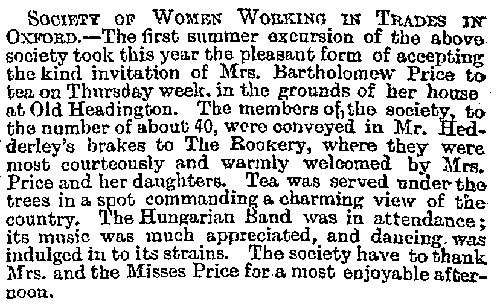
Mrs Price renamed her house Charlton House (or Charlton Lea), probably in memory of her husband, whose birthplace was Charlton Kings in Gloucestershire. Although it is shown with its new name in Kelly’s Directory from 1900 onwards and on the 1921 OS map of Headington, it was still referred to as The Rookery in other contexts, including the above article.
Only Mrs Price’s butler, cook, housemaid, and kitchenmaid were at home in the Rookery at the time of the 1901 census.
Mrs Price died at the Rookery/Charlton Lea at the age of 74 on 14 October 1909 and was buried at Holywell Cemetery with her husband.
The Rookery was then bought by Dr John Massie (1842–1925) (see ODNB), who retained the name of Charlton Lea for the house. Massie, who had been Professor of New Testament Exegesis at Spring Hill College, in 1886 had moved with his college (which was to become Mansfield College) from Birmingham to Oxford, and until 1910 had lived at 101 Banbury Road.
An article in the Oxford Chronicle for 14 October 1910 (p. 9) describes the extensive improvements Massie made to the house, including electric lighting. The architects were Messrs W. W. & G. A. Harrison of Turl Street, the builders Messrs Knowles & Son of Holywell Street, and the consulting engineers Messrs Best & Son. The 1911 census shows John Massie (68) in retirement at Charlton Lea with his wife Edith (62): they had no children. Seven domestic servants lived in the house with them, and they also employed twelve outdoor staff. They are again listed here in the 1921 census.
John Massie died at 84 Harley Street at the age of 82 on 11 November 1925 following a motor accident in London and was buried in Headington Cemetery on 14 November 1925. His effects came to over £110,296. His widow Edith Mary Massie died at Charlton Lea (The Rookery) on 11 February 1933 at the age of 84 and was buried with him. Her effects came to over £162,628.
The Massies had no children, and Mrs Massie's executors put The Rookery/Charlton Lea up for sale with the following advertisement:
OLD HEADINGTON, OXON
Announcement of SALE as a Whole or in Lots of the highly attractive RESIDENTIAL PROPERTY known as
CHARLTON LEA,
comprising a dignified old-world Residence, with hall, three well-proportioned reception rooms, billiard room (all with oak floors and superior oak fitments), seven principal bedrooms, three bathrooms (h. and c.), complete offices; garages and stabling; electric light, main water, central heating; charming matured pleasure grounds, shrubberies, lawns, farmery, rich pastureland; in all about
22½ ACRES. VACANT POSSESSION
For sale PRIVATELY or by AUCTION during May by JAMES STYLES & WHITLOCK....
The house and its extensive grounds were bought by the Colburn building firm of Swindon in 1933, but Oxford City Council refused to grant permission for development. .
In 1934 the house and lands were bought by Sir Michael Sadler (1861–1943) (see ODNB) on his retirement as Master of University College, and he restored its original name of the Rookery. The northern bypass bisected its fields to the north in 1935. Sadler died at the Rookery on 14 October 1943.
Michael Thomas Harvey Sadleir [sic], Sir Michael’s only son, inherited the Rookery and on 15 May 1944 sold it to Aubrey Edward Gurden, who had co-founded the Oliver & Gurden bakery.
During the Second World War the house’s grounds were requisitioned by the War Office. The American army camped there in Nissen huts and later used the house as a convalescent home.
In 1946 Gurden let out the whole Rookery estate to Ruskin College, which was outgrowing its cramped Walton Street premises, and on 10 October 1947 sold it to the college (less a chunk of land which was retained for a new house at 4 Dunstan Road, which was confusingly given the Rookery’s old name of Charlton Lea).
The Rookery became known as Ruskin Hall, an educational establishment very different from the “young noblemen’s school” that occupied the building in 1869: for Ruskin College is committed to equal opportunities and has educated adult students from the working class since 1899.
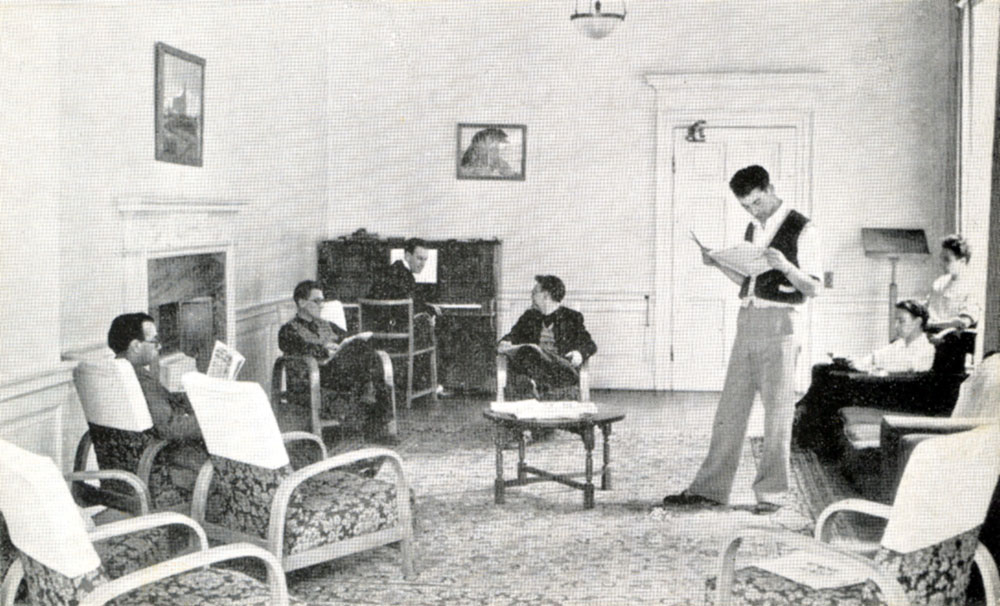 Postcard showing Ruskin College’s former Common Room in the Rookery
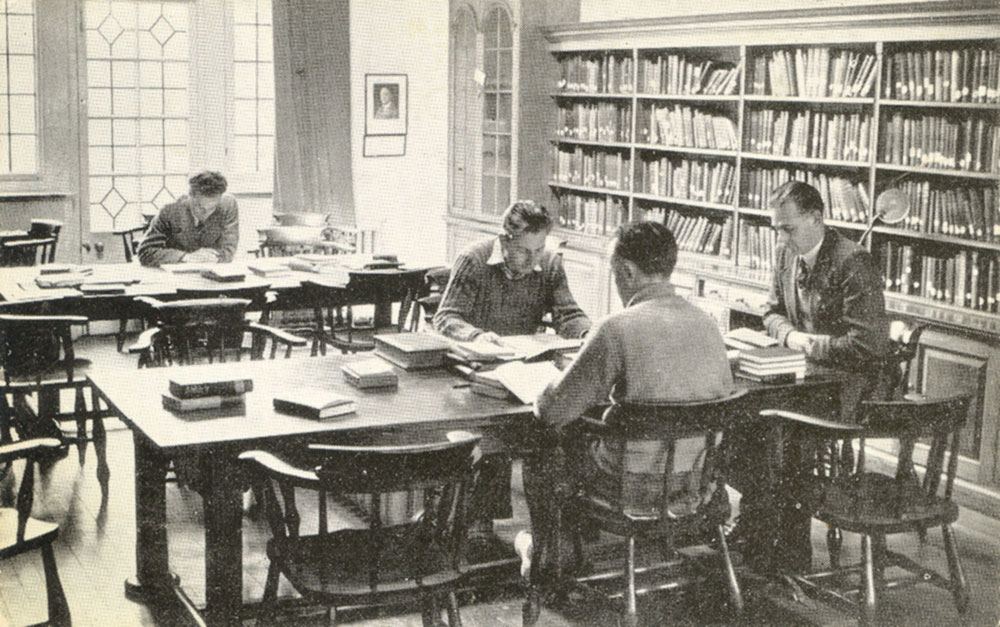 Postcard showing Ruskin College’s former library in the Rookery
Planning permission was granted to Ruskin College in the early days as follows:
- 1949: to convert the stables of The Rookery into student rooms (49/00420/A_H).
- 1958: to build a new student hostel (59/07663/A_H), and the Daily Telegraph announced on 26 June 1959 that a new student block to accommodate ten students and a common room would be opened at The Rookery two days later.
- 1964: An extension to provide 46 study bedrooms, four tutorial rooms, a dining hall, servery, and lecture hall (64/15297/A_H)
In 1965 the college also bought Stoke on the other side of Stoke Place.
Ruskin College in the twenty-first century
Ruskin College sold its premises in Oxford to Exeter College, and in the autumn of 2012 when a major new building adjacent to the former Rookery was complete it moved its entire operation to Headington:
Following financial difficulties, in March 2021 the college sold its annexe, Stoke House to Linacre College, Oxford.
Ruskin College was taken over by the University of West London in July 2021.
The Ruskin Fields running down to the bypass are currently under threat of redevelopment, and Oxford City Council has agreed that a road can run through to it from Foxwell Drive, Northway (obliterating its “tiny forest”) if planning permission is granted.
