


Stoke House, Stoke Place (part of Linacre College)

List entry for Stoke House: 1051679
Stoke House was built in 1883, but its core is probably a seventeenth-century cottage. The lane in which it stands, which leads down to the footpath to Elsfield, was known in the nineteenth century as Love Lane, but in 1929 it was officially named Stoke Place after this house. The four neighbouring cottages to the south were built in 1885 and were originally known as “Rookery Cottages”.
The house was described thus by the Royal Commission on the Historical Monuments of England, published in 1939:
(275) Stoke, house 130 yards N. of the church, is of two storeys with attics; the walls are of rubble. It is largely modern but incorporates a 17th-century cottage. Condition—Good.
The Revd John William Augustus Taylor who lived in the Rookery (now Ruskin College) also owned the land on the east side of the lane (which had been awarded to the Finch family of the Rookery under the Headington Enclosure Award of 1804), and in 1883 he built this smaller house for his retirement. He may have named the house Stoke after Stoke near Plymouth, Devon, where his late wife, Jane Mould, had been born and where they had married. He only lived in this house for three years, as he died in 1886.
Taylor’s daughter Sarah and her husband Robert Henry Dockray then inherited this house. (The 1881 census showed Dockray as a bachelor teacher of 37, working under his future father-in-law at the Rookery School and lodging with a gardener and his family in Rookery Cottages; soon afterwards he married Miss Sarah Mary Louisa Taylor, also aged 37.) In the 1881 census and thereafter, Sarah is described as a painter in oils, and she exhibited her work at the Royal Academy (as her grandmother, Maria Spilsbury Taylor, had done before her). In 1891 Dockray is described as a private tutor; and in 1911 when he was 67 as having no occupation. The Dockrays lived at the house until about 1914; they had no children.
From 1915 the house was occupied by Major William Lauriston Melville Lee (1865–1955), a secret agent who was later President of Headington United Football Club. The 1921 census shows Major Lee (55) living at Stoke with three servants. He died at the Cowley Road Hospital on 29 October 1955 and was buried in Headington Cemetery on 3 November. His effects came to just over £11,562.
His son Rupert Henry Melville Lee remained at Stoke House for ten years after his father's death. In about 1959 he sold much of its land, and 8, 9, and 10 Stoke Place were built in its garden. He then sold the whole house to Ruskin College when he moved to Malta in 1965.
The postcard below of Stoke House dates from shortly after it was sold to Ruskin College in 1965.
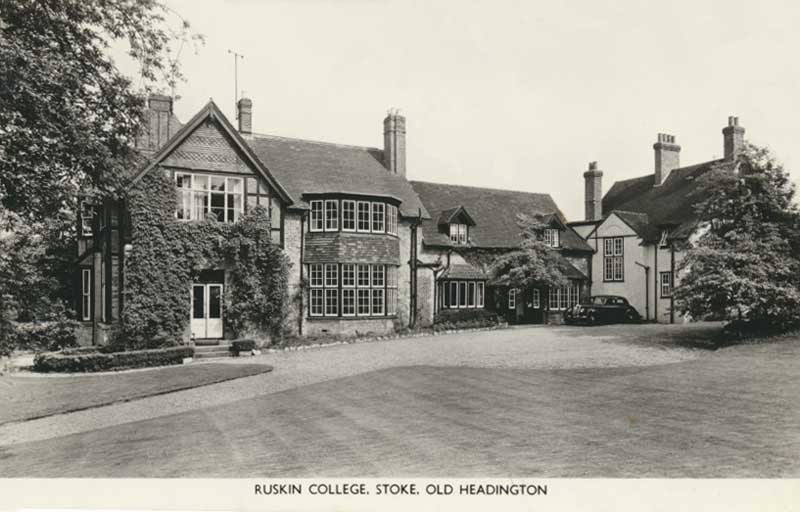
In c.1990 extensions were added to the rear, with dormer windows above.
After renting Stoke House for a year, Linacre College, Oxford bought it from Ruskin College in March 2021. A planning application submitted by the college in November 2024 contains photographs and detailed information about the house in its Design & Access and Heritage Impact Statements: 24/02743/LBC
