


Highfield Farmhouse, 23 Highfield Avenue

Above and below: Photographs of Highfield Farmhouse provided by
Danby and Sandy Bloch
who were given them by Arthur Treen, the police constable who lived here from 1927 to 1930


Highfield Farmhouse at 23 Highfield Avenue is a well-kept secret. It can only just be seen from the road, and the best view is probably from the Valentia Road recreation ground when the trees are not in leaf. It stands at an odd angle to the pavement because it pre-dates the road by about 225 years.
List entry for Highfield Farmhouse: 1369391
Photograph of the farmhouse on Picture Oxon
Map centred on Highfield Farm in 1899,
side-by-side with a modern map
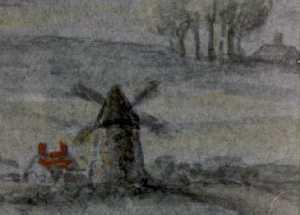
The farmhouse dates from around 1700, when it was the only building between the windmill of Windmill Road and the settlement at the top of Headington Hill.
In the detail from an 1820 painting of Headington (right), the farmhouse can be seen at the top right, to the north-west of the windmill in Windmill Road.
The lands of Highfield Farm lay between London Road and Old Road, to the west of New High Street. It was originally known as Headington Hill Farm and later as Rookery Farm, but was also sometimes described by the name of the current owner, e.g. Knowles’ Farm or Parker’s Farm. It occupied four portions of land awarded to the Finch family of the Rookery under the Headington Enclosure Award of 1804, which came to about 113 acres; but the Finches must have purchased additional land in Highfield, as the Headington Rate Book of 1850 shows that Richard Finch then let out over 150 acres of land “below the Britannia” to Thomas Knowles. The Boundary Brook ran through its land.
The censuses of 1851 and 1861 census shows Thomas Knowles living in Highfield Farmhouse, and he is described in the latter census as a farmer of 161 acres employing eight men, four women, and two boys. The farmlands stretched from New High Street in the east to Gipsy Lane in the west, and to the north as far as London Road. To the south, it extended beyond Old Road into the Warneford Fields. At the time of the 1871 census the farmhouse was occupied by two agricultural labourers described as temporary lodgers.
In early 1875 the Reverend Augustus Taylor, the then owner of the Rookery, decided to sell off the land of Highfield Farm. On 26 June 1875 the farm was advertised to let:
TO BE LET BY TENDER,
HEADINGTON HILL FARM, HIGHFIELD ESTATE, OXFORD.
This most desirable Holding, within one mile of the City of Oxford.
THE above, containing an area of 138 Acres (more or less) of Arable and Pasture Lane, to be LET by TENDER, from Michaelmas next.
On 11 September 1875 it appears to have been advertised again:
FARM TO BE LET — HEADINGTON HILL FARM, Headington, Oxford, with immediate possession — Arable, 123A. 3R. 11P.; Pasture, 31A. 0R. 0P.
The farmland began to get eroded as the Highfield Estate was developed in the 1880s: first of all, a large villa was built on the north edge of the farmland (Ellerslie, now Dorset House) and a large house to the south (Highfield Cottage, now 61 Old Road). Then came Brookside (now Headington Junior School) and a whole new street (most of the present Lime Walk) to the east. In the 1890s and early 1900s the other roads of the present Highfield area crept relentlessly westwards towards the farmhouse.
On 27 November 1880 W. H. Gardner advertised in Jackson's Oxford Journal that he was quitting Highfield Farm and that he was selling his live and dead farming stock and effects, including four cart horses, one wagon, three carts, ploughs, drags, rolls, harness, etc.

At the time of the 1881 census, the farmhouse was occupied by a farm bailiff, Percival Stockford, and his wife and five children; the farmer at that time was probably John Kingston, listed for certain as farmer there in 1883.
In 1887 Abraham Parker was a faggot dealer here, but the 1891 census shows him living in Woodman’s Villa in New High Street.
The advertisement on the left from Valter’s Directory of 1887 shows that J. Hathaway was then running a horse-slaughtering business at the farm.
In the 1891 census “Parker’s Farm” was listed as uninhabited.
The Debron family and Highfield Farm
The next farmers, on a Highfield Farm that was much reduced in size because the Highfield Estate was being built on its land, were the Debrons.
Henry James Debron (27), the son of a St Clement's grocer, had married Sarah Wheeler of Marston Street, the daughter of the tailor Richard Wheeler, at St James's Church in Cowley on 30 May 1869. He became a pork butcher. He was not the farmer here for long, and died at Highfield Farm on 8 July 1896; but his wife, Mrs Sarah Debron continued to run the business on her own with the help of her son Henry. The 1901 census shows her as a widow of 54, living in the farmhouse with her son, three daughters, and a 14-year-old servant-girl: she was described as a butcher, and her 24-year-old son Henry was her employee. Mrs Debron then moved down to 144 Cowley Road, where she can be seen in the 1911 census: she was still described as a butcher, as she continued to run the farm until about 1913.
Her daughter Zoe Debron had married the butcher Sidney Richard King at Bounds Green, Haringay on 22 April 1892, and by 1911 Mrs Sarah Debron had let the farmhouse out to Sidney's mother, the widowed laundress Mrs Fanny King, who lived there with two of her children: Esther Piddington, who was the Headington district midwife, and Walter Debron (17), who was a grocer's assistant. (Fanny's son, Frederick James King, died in the First World War and is on the All Saints' Church war memorial.)
Mrs Zoe King, née Debron, took over her mother's farm in about 1913 and remained here until 1916.
In the late twentieth century some local people still called the slope in Old Road that leads up from the farm “Debron’s Hill”.
Highfield Farmhouse as a private house
Since 1917 Highfield Farmhouse has been a private house and until the Gipsy Lane council estate was built on its remaining lands west of the Boundary Brook in the late 1920s they were used as nursery gardens. The private occupants listed in Kelly's Directory were as follows:
- 1917 –1921: Miss Reading
- 1921–1926: Henry Dowrick
- 1927 –1930: Arthur Henry Treen
The 1921 census shows the draper's traveller Henry Dowrick (35) living at Highfield Farmhouse with his wife Helena and their three children.
The farmhouse was destined to be demolished when Highfield Avenue was laid out in the early 1930s and was unoccupied in 1933, but mercifully it was saved at the last minute. Its address henceforth was 23 Highfield Avenue.
- 1935 –1936: James Pike
- 1938 –1941: George William Jakeman
- 1943 –1972: Percy Frederick Giles
- 1973–1983: Andrew C. Bloch (known as Danby Bloch)
