


Dorset House, 58 London Road (demolished)

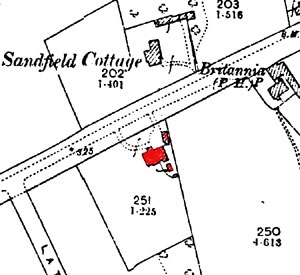
This villa (known in its latter years as Dorset House) was built on the south side of the London Road in 1878. For eight years it was the only house between the Britannia and the top of Headington Hill (see 1898 map, right).
It has had the following names over the years:
- 1878–1899: Ellerslie
- 1899–1920: Hillstow
- 1920–1961: Headington School: Hillstow Annexe
- 1961–2004: Dorset House
School of Occupational Therapy
“Ellerslie” (1878–1897)
This was one of the first two houses to be built on the land of the old Highfield Farm. The owner of that farm, the Revd John Taylor of the Rookery School in Old Headington, had in 1875 tried to sell the farm lands to developers. He was unsuccessful, and In 1877 took action himself and had two houses built on the land. One was this large villa facing the London Road, and the other a sizeable cottage now numbered 61 Old Road.
As the following advertisement that appeared in Jackson’s Oxford Journal of 29 June 1878 shows, the villa was already named Ellerslie (presumably after the castle near Glasgow) before it was occupied:

The pair of houses were eventually auctioned at the Roebuck Hotel in Oxford on 20 November 1878. The advertisement for the sale in Jackson’s Oxford Journal describes the future Dorset House as follows:
THE HIGHFIELD ESTATE, HEADINGTON
Lot 1. The freehold villa residence, called “Ellerslie”, situate on the Highfield Estate, Headington, and adjoining the London Road. On the ground floor are entrance hall, cheerful drawing and dining rooms, breakfast room, Kitchen, scullery, housemaid’s closet, larder, cellar, lavatory, and w.c. On the first floor are 4 good bed rooms, with bath room and w.c., and there are also 3 attics. A force pump in the scullery gives an ample supply of water over the House. There is a large piece of garden ground which, with the site of the House, comprises exactly an Acre, and there are two carriage entrances from the road.
“Ellerslie” is very pleasantly situate on a dry and healthy soil, and commands charming views of Oxford and the neighbourhood. It is of recent erection and exceedingly well-built of brick and tiled.
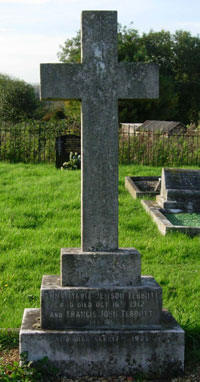
Mrs Anna Maria Jemson Tebbutt, born in Helmdon, Northants and widow of the clergyman Francis Tebbutt, was the first person to occupy the house. The 1881 census shows her there at the age of 51 with her undergraduate son Francis John (22) and daughter Mary (18), plus a housemaid (15) and a cook (17).
On 27 June 1888 at St Andrew’s Church her daughter Mary (27) married a solicitor of Wotton-under-Edge, Colin Campbell I. N. Thorn (29). By 1891 Mrs Tebbutt was living alone in this large house, still with two servants.
Mrs Tebbutt remained here until 1897, when she moved to Westbourne Terrace on the London Road (the house that is now Chancellor’s Estate Agents), and by the time of her death in 1912 she was living at North Lodge (now 10 St Andrew’s Lane) in Old Headington. Her son Francis died in 1925 at the Acland Home at the age of 67.
Right: Tombstone in Headington Cemetery
of Anna Tebbutt (died 16 October 1912) and her son
Francis John Tebbutt (died 17 September 1925)
”Hillstow”: 1897–1919
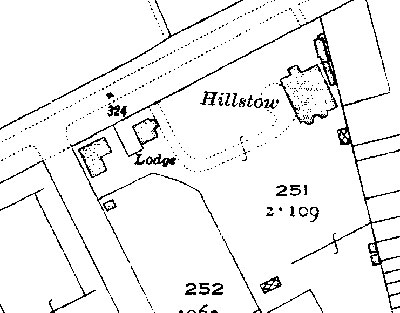
In 1897 the social reformers the Misses Rosamund and Florence Davenport Hill moved into the house in their retirement and renamed it Hillstow. The 1901 census shows the two sisters (aged respectively 78 and 71) waited on by five servants: a cook, parlour maid, two housemaids, and one maid. Their coachman and his family lived in Hillstow Lodge, which the Davenport-Hills probably had built after they moved in (see 1921 map, right). There is also a cottage on the corner of Latimer Road (42 London Road), which is all that survives today.
Rosamund Davenport Hill died at Hillstow in 1902. The 1911 census shows her younger sister, Florence Margaret Davenport (82), still living at Hillstow with a companion, Miss Mary Cecilia Butts Howell (40), and four servants (a cook, parlourmaid, housemaid, and under-housemaid). Hillstow Lodge was occupied by their domestic coachman Joseph Mole (45), his wife Sarah (53) and their children Francis (19), Louisa (18) and Gladys (14).
Florence Davenport Hill was an important suffragist, and in 1913 the Great Pilgrimage made a special point of stopping here at Hillstow House as it passed through Headington on its way to the Hyde Park rally:
- Oxford Journal Illustrated, 23 July 1913, p. 9: Photograph of Miss Davenport Hill at Hillstow with members of the procession of the Non-Militant Suffragettes’ Pilgrimage
Florence Davenport Hill died on 2 November 1919 at the age of 90. Her obituary appeared in The Times of 5 November 1919, and included the following about Hillstow:
The beautiful home at Headington was open to all – young and old, rich and poor – and after the death of her elder sister Miss Hill continued this course to the very last. Her hospitality was graced by sympathy, delicate courtesy, and the conversation of a full and gifted mind.
It was written of Hillstow during the war:–
Here weary workers rest
And wounded heroes play;
Refreshed from strait or fray;
Each one an honoured guest.
More information on the Misses Rosamund and Florence Davenport Hill
Hillstow Annexe of Headington School: 1920–1964
From 1920 to 1964 this house was part of Headington School and was known as the Hillstow Annexe.
The 1921 census shows the house mistress, matron, music mistress, cook, parlour maid, house maid, and kitchenmaid of Headington High School for Girls living in Hillstow with six boarders aged between 11 and 16.
Miss Muriel Joan Porcher (38), described as the head mistress of St Stephen's High School in Clewer, Windsor and a part-time student at the University of Oxford, was living at Hillstow Cottage in 1921 with her servant. She was the headmistress of Headington School to 1923), followed by Miss Pybus (1923–1925) and Miss Spink (1926–1929).
From 1930 to 1960 it is listed as “Headington School for Girls Ltd (annexe)”, and in 1962 and 1964 as “Headington School (boarding house)”.
Dorset House School of Occupational Therapy: 1964–2004
The original “Dorset House” (the first school of occupational therapy in the UK) was founded in Bristol in 1930 by Dr Elizabeth Casson. It moved to Oxford in 1946 and first occupied Nissen Huts in the grounds of the Churchill Hospital.
In 1961 the Dorset House Casson Trust purchased this house from Headington School, and in 1964 the Dorset House School of Occupational Therapy moved in, giving the house that had first been called Ellerslie and then Hillstow its third and final name of Dorset House. It was officially opened in 1965.
In 1997 Dorset House merged with the School of Health Care Studies of Oxford Brookes University, forming the new School of Health Care. When this School moved into the former Milham Ford School on the Marston Road in 2004, Dorset House was closed. and sold to property developers. It was demolished in 2009.
Extract from Local Plan, 2001–16
Dorset House, London Road, Headington
14.2.40 This site is now vacant, having been occupied by Oxford Brookes University’s School of Occupational Therapy, which has relocated to Milham Ford School. The County Council is looking for a new site for Headington Library and as this site is readily accessible from most parts of Headington it is considered suitable. In addition, the site could be used for institutional uses, such as community facilities, nursery education/childcare or healthcare facilities.
14.2.41 Given the site’s location close to the Headington Hospital sites, provision of nurses accommodation and key-worker housing would be particularly suitable. Alternatively the site could be developed for student accommodation for Oxford Brookes University and/or the University of Oxford.
POLICY DS.27 – DORSET HOUSE, LONDON ROAD – MIXED-USE DEVELOPMENT Planning permission will be granted at Dorset House, London Road for a
|
Quintain property developers 2006–2010
First (withdrawn) planning application: 2006
In 2006 Quintain (the property developers who had bought the entire 82,000 sq.ft. Dorset House site) submitted plans to demolish the house itself as well as 42 London Road and 1A Latimer Road, and to erect five blocks of accommodation for 363 students.
Following a recommendation from planners that it be turned down, it withdrew this application (06/01628/FUL).
- Oxford Mail, 20 October 2006: “Student hostel scheme dropped”
- Oxford Mail, 8 September 2006: “University to knock down Victorian house“
Demolition by Quintain in 2009
Dorset House was neither a listed building nor in a Conservation Area, so Quintain did not need permission to pull it down. In May 2009 a demolition company working for Quintain informed the city council that they were going to demolish all buildings on the Dorset House site except for the three nearest the corner of Latimer Road and London Road. Demolition work started on Monday 8 June 2009.
 Dorset House being demolished, 2 July 2009
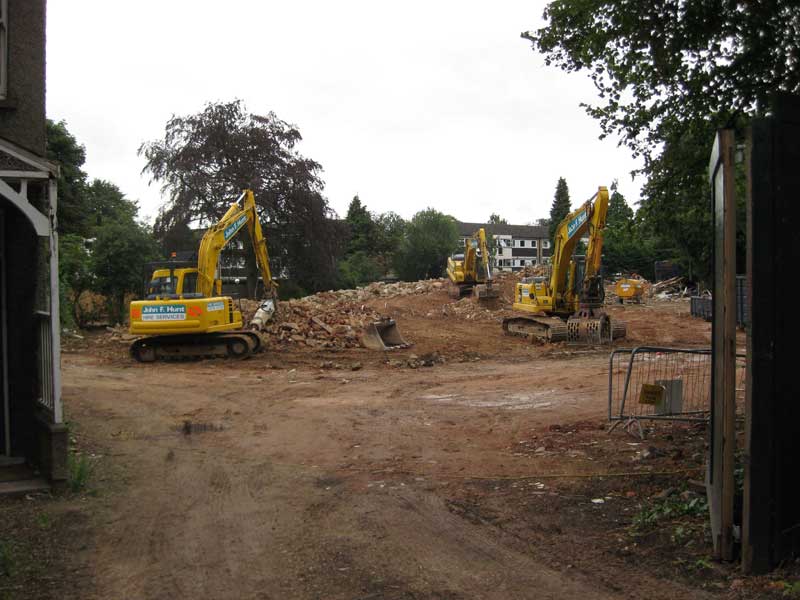 The site after demolition, 22 July 2009
No subsequent planning application was submitted by Quintain, except 09/01274/TPO to remove a large copper beech tree suffering from Meripilus root decay, and permission was not required to do this.
Berkeley Homes: since 2010
Quintain sold the site to Berkeley Homes for £5m in September 2010, and their pre-close statement at the end of the financial year said:
Dorset House, Oxford
Contracts were exchanged in September regarding the sale of a plot of land in Oxford known as Dorset House. The disposal for £5m demonstrates a premium to valuation of £1.3m and is in line with our strategy of releasing capital when advantageous from non-core assets to recycle into our major schemes.
Berkeley Homes submitted planning application 10/03136/FUL for:
“Demolition of 1a Latimer Road and 44 London Road. Alterations to 60 London Road and erection of 3 buildings of 2,3 and 4 storeys to provide 316 student bed spaces, ancillary accommodation, plant and secure and integrated cycle storage for 160 cycles. External works including associated communal space 4 car parking”.
The plans were agreed in principle at the meeting of the Strategic Development Control Committee on 31 March 2011 and were fully approved on 20 April 2011. Roy Darke explained on the Headington & Marston Neighbourhood Forum:
The Committee was concerned about the impact of the south westerly block on the nearest existing block within Latimer Grange. That is why an “in principle” decision was agreed. The developer will be asked to go away and re-design the SW block to reduce its “seen height” from Latimer Grange and deal with proposed windows that overlook Latimer Grange. Three additional conditions were added to those already in the officer’s report. They were:
(1) about occupancy – only by students in FT education of a least one year duration with a local educational institution in the city;
(2) reinforcement of no-car model policy required by Brookes etc. on students living in this development;
(3) the developer is required to prepare a management plan about. inter alia, no. of wardens, management of potential nuisance to neighbours and to hold a meeting with residents, local community, staff and residents of McMaster House and staff at St. Luke’s prior to finalising and getting agreement to the management plan from the Council.
There was also agreement to a Grampian condition for off-site works intended to help McMaster House and St. Lukes put in measures to stop rogue parking at the developers expense. This is a bit of a belt-and-braces condition to stop Dorset House students who might smuggle a car into Oxford but also reflecting a concern in SDCC and speakers about parents etc. coming to see or pick up offspring and parking illegally when they cannot park on Dorset House site. The draft s.106 agreement was also amended to seek monies for facilities (library spending is mentioned) should be spent locally. Also the monies identified for improvements to cycling was added to to include other traffic management measures with intention of further speed reduction measures in Highfield.
Work on the site started in April 2011, and the first students arrived in September 2012.
On 5 September 2012 the freehold of Dorset House (Unite Student Housing) was sold to Morgan Sharp Investment Ltd, a company registered in Guernsey, for £28,0000 (ON303816).
- Oxford Mail, 2 April 2011: “Student flats plan gets the go-ahead”
- Oxford Mail, 3 December 2010: “New plans for student housing in Headington welcomed”
- Oxford Mail, 28 October 2010: “Headington student flats proposal revived”
