


John Johnson (1882–1956)
Printer to the University who lived at 29 Barton Lane from 1026 to 1056
Collector of the John Johnson Collection of Printed Ephemera
John de Monins Johnson was born on 17 May 1882 at Brocklesbury Rectory in Kirmington, Lincolnshire. He was the son of the Rector, the Revd John Henry Johnson, and Anna Braithwaite Savory. His parents were married at Sunningdale in Berkshire on 20 June 1876, and John's two older siblings were also born at Kirmington: Herbert Braithwaite Johnson in 1877 and Anna Maria Johnson in 1879.
At the time of the 1891 census John (3) was living at Kirmington with his father John (50), his mother Anna (43), and Herbert (13) and Anna Maria (11). The family employed a governess, cook, groom, and two housemaids.
John Johnson first came to Oxford when he was sent off as a boarder to Magdalen College School. He then went up to Exeter College, Oxford to read Literae Humaniores (Classics). The 1901 census shows him at the age of 18 and described as an undergraduate at Oxford back home for the vacation in Kirmington with his parents and his sister Anna (21), plus their four servants.
After his Finals in 1904 Johnson remained in residence for another year to learn Arabic, and he then worked in the Egyptian civil service from 1905 to 1907.
He then returned to Oxford and was a Senior Demy (demi-socius, or half-fellow) at Magdalen College from 1909 to 1912. During this period he edited papyri and also conducted explorations in Egypt, and discovering the earliest known manuscript of Theocritus.
He was also a collector of printed ephemera, which he defined as “Everything which would ordinarily go into the wastepaper basket after use, everything printed which is not actually a book”.
Johnson was deemed unfit for active service in the First World War and in 1915 was appointed acting Assistant Secretary to the Delegates of Oxford University Press, and later Assistant Secretary.
On 31 July 1918 at St Peter-in-the-East Church, Oxford, John de Monins Johnson, who was then living in Holywell, married Margaret Dorothea Cannan, known as Dorothea. She was born in Oxford on 21 November 1892, the daughter of Charles Cannan, Tutor of Trinity College and the Secretary to the Delegates of the Clarendon Press, and lived at Magdalen Gate House in the High Street.
The 1921 census shows John Johnson (39) described as a publisher and living at 15 Linton Road, Oxford with his wife Margaret and his sister-in-law May Cannan, who was an authoress, and their housekeeper.
John & Margaret Johnson had two children:
- Charles Cannan Johnson (born in Oxford on 8 December 1921)
- Paula Bolingbroke Johnson (born in Headington on 17 March 1930); she was registered with her first name spelt Paula, but it was usually recorded as Paulla.
In 1925 Johnson was appointed Printer to the University, and he remained in this post until his retirement in 1946.
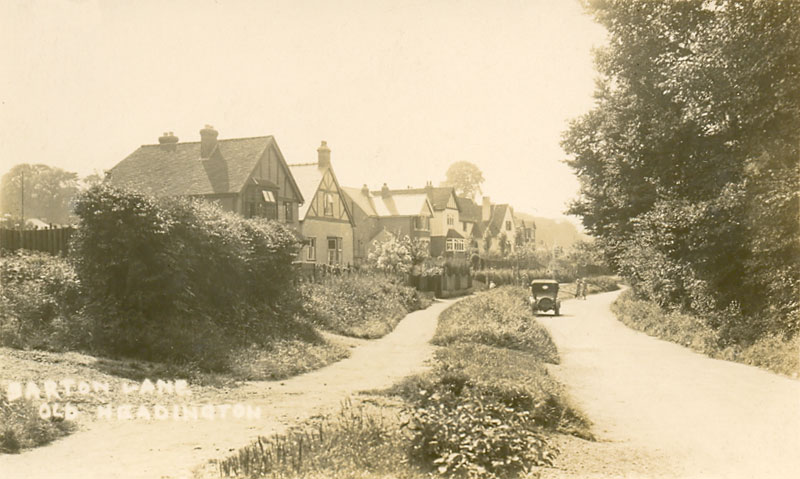
By 1929 John Johnson and his family had moved to Headington, where they lived in a new house called Bare Acres in Barton Lane. Later numbered 29 Barton Lane, this is the first house to the east of what is now Chestnut Avenue.
The 1939 Register lists his wife Margaret Dorothea Johnson at Bare Acres in Barton Lane with their children Charles and Paulla, but John himself spent the years of the Second World war at the Clarendon Press Printing Works in Walton Street, where he is duly listed as the Controller of the Printing Works. The only other occupant of the Printer's House at the Press was William Thrussell (born 1912), who was a clerk and telephonist.
In 1932 John Johnson helped G. A. Coppock and B. M. Hill produce their book, Headington Quarry and Shotover: A History compiled on behalf of Quarry Women's Institute, and enabled it to be printed by Oxford University Press in 1933.
Barton Lane was very rural when the Johnsons moved in: it was the ancient route from the hamlet of Barton to the village of Old Headington. This soon changed in the 1930s when Chestnut Avenue, Ash Grove, and Hawthorn Avenues were laid out, followed in 1935 by the completion of the nearby Northern Bypass, and the development of Barton estate in the 1940s. In the early 1950s Joanna Cannan, the sister of his wife Dorothea Cannan, wrote scathingly of the development that had taken place in the Barton Lane area, presumably after paying them a visit.
John de Monins Johnson lived at 29 Barton Lane for the rest of his life, retiring as Printer to the University in 1946.
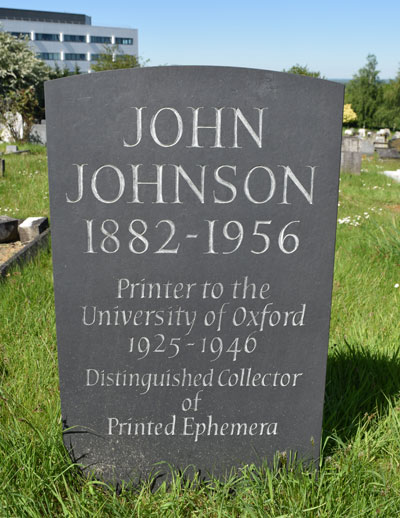
He died at the Radcliffe Infirmary at the age of 74 on 15 September 1956 and was buried at Headington Cemetery on 19 September (Grave S172). His headstone (right) reads:
JOHN JOHNSON
1882–1956
Printer to the
University of Oxford
1925–1946
Distinguished Collector
of
Printed Ephemera
His effects came to £25,582 9s. 1d.
Johnson is best remembered today for the John Johnson Collection of Printed Ephemera held by the Bodleian Library.
His son Charles Cannan Johnson, who was a journalist, was living in Toronto in Canada when he died in Bath, Somerset at the age of 42 on 14 March 1963 and was also buried in Headington Cemetery (Grave S153). His effects came to £356, and his executor was his widow, Frances Elizabeth Johnson.
Obituary of John de Monins Johnson published in The Times on 17 September 1956
MR. J. JOHNSON
OXFORD PRESS PRINTERMr. John Johnson, C.B.E., Printer to the University of Oxford from 1925 until 1946, died on Saturday at the age of 74.
Born in a Lincolnshire vicarage in 1882, John de Monins Johnson passed from Magdalen College School to Exeter College, Oxford, where he read “Greats,” and in 1906 joined the Egyptian Civil Service. Shortly after the retirement of Lord Cromer, he turned to archaeology and from 1908 to 1914 was a member of the Graeco-Roman branch of the Egyptian Exploration Fund. He was still a papyrologist when he became acting assistant secretary to the Delegates of the Clarendon Press in 1915, a heart strain having made him unfit for military service; but his edition of two papyri of Theocritus which he had discovered had then to be laid aside, and was ultimately completed by A. S. Hunt.
Throwing himself into his new occupation with an energy which seemed to some of his friends to be disturbing to the established habits of a university press, he planned new series and in one way or another revealed unexpected capacity for business. As a designer of books he excelled in providing them with illustrations, which were often all chosen by himself. In 1925 he volunteered to leave the publishing branch of the Oxford Press in order to become its Printer. During his rule – for such it was – he planned structural alterations, decided for a “closed house,” and introduced various changes which were to fit the Oxford Press to cope with the great volume of work assigned to it by the Government and the Allied Command during the war. Every man and woman knew on clocking in that the Printer was already in his office and would be there when the day’s work was over; he even slept in his office while there was the fear that Oxford would be bombed, and continued to sleep there till the very end of the war.
He became the leading authority on the history of the Oxford Press. His Print and Privilege at Oxford to the year 1700, written in collaboration with Strickland Gibson, threw new light on its beginnings, and also on publishing in London in the seventeenth century. But his investigations were not confined to the book trade. Whereas the historical study of printing had hitherto been almost solely bibliographical, his interests spread to all branches of the printer’s craft. He collected specimens of every kind of English printing from broadsides and old bank notes to valentines and posters – he called them his “ephemera” – and gradually formed a museum which soon attracted experts from abroad, and is of great value to the social historian. It was the only museum of this kind in the country, and was the property of the university.
His gift of seeing the significance of objects from the past was remarkable, and he was never bound by the tastes and fashions of the moment. As a collector he took no more interest in one period than in another; as a printer he tried to ensure that the work of his press was not mannered but equally good in different styles. Once his interest was engaged in any project he gave his mind to it with enthusiasm, and his great fund of miscellaneous and out-of-the-way information was always at the service of others. He seemed to think little about himself; and the wide circle of his acquaintances and employees have many acts of kindness to remember.
He was appointed C.B.E. in 1945, was an Honorary Fellow of Exeter College, and was given the honorary degree of D.Litt. on the completion of the Oxford English Dictionary in 1925.
He married in 1918 Margaret Dorothea, daughter of Charles Cannan, by whom he had a son and a daughter.
There is a
much fuller entry on John Johnson in the Oxford Dictionary of National Biography
The ODNB online is available free to many public library users, including those in Oxfordshire:
put your library ticket number in the “Library Card Login” box
