


Headington in 1952
It was worse to lose Headington [to the jerry-building of flimsy homes for the workers], always an entrancingly sinister village, secret behind high walls, decadent with condemned cottages, endemic with scarlet fever, littered with gypsy encampments, enriched by an area – Quarry – which policemen dared not enter save in pairs. The stony main street and chestnut-darkened alleys retain their old savour of malevolence: furtively the larger houses – actually inhabited by the jolly families of distinguished members of the University – cold-shoulder the pavements and direct the sly looks of their mullioned windows into their own high-walled courtyards.
Oblivious to the ceaseless roar of the by-pass road and the proximity of the dolls-house homes of Chestnut Avenue, in the drear months of January and February a ghost with uncombed hair wanders in Barton Lane. The farms of the neighbourhood, drowning in the tide of bricks and mortar, keep their Cold Comfort character to the end. Now the bright ripples of the Bayswater brook must disappear into pipe and culvert, and the rough and reedy Barton Fields vanish under handkerchief lawns and crazy paving. The fate of the genius loci is a matter for speculation – will it take itself off or remain to vex the home-makers, sowing thistles in the gardens and dissension among the neighbours, cracking the concrete, twisting the plastic, until the neat bright suburb is absorbed into the identity of the passionate crumbling village that we knew?
Joanna Cannan, Oxfordshire (London: Robert Hale Ltd, 1952)
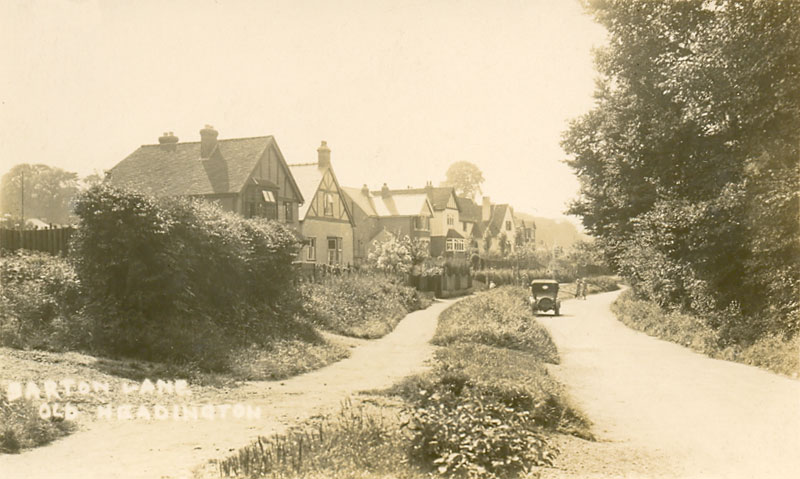
Barton Lane, when the houses were new
Joanna Cannan (Mrs Pullein-Thompson) (1898–1961)
Joanna Cannan was the youngest daughter of Charles Cannan, secretary to the delegates of Oxford University Press. She would have known Barton Lane because her sister Dorothea was married to John Johnson and lived there in the house called Bare Acres from 1929 to 1956. The building of the northern bypass in the mid-1930s drastically changed the nature of this country lane.
Here Cannan is deploring the development of the Barton estate in the 1950s, and simultaneous regretting the earlier development in the 1930s of Between Towns Field, where the building of Chestnut Avenue, Ash Grove, and Hawthorn Avenue brought suburbia to the doorstep of Old Headington (and particularly to her sister’s house in Barton Lane).
Joanna Cannan was famous for her pony stories for children and her detective novels, and her three daughters Josephine Diana, and Christine also wrote pony books.
Occupants of Barton Lane in 1935 (from Kelly's Directory)
Barton Lane was not numbered until c.1955, and the present
names
and/or numbers are given in square brackets
North side
1 Walter James WHEELER [Mather's Farm]
South side, going eastwards
Frederick MASTERS (Greenfields) [35]
Francis George WYATT (Braemar) [33]Here is Chestnut Avenue
John JOHNSON (Bare Acres) [29]
James S. BOSWELL (St Helier) [25, latterly called Endways]
Misses RHYS (Gwynva) [19]Here is Ash Grove
Charles R. HEWETT (Langtree) [17]
Thomas A. TAYLOR (Havelock) [15]
Georges [sic] BAIRD (North View) [9]
Joseph WILSON (Scardeburg) [7]
Chares Thomason DERNFORD (Toolangi) [5]
Miss ALLEN (Above Mead) [3]
John H. GRAHAM (The Moorings) [1]
Alfred George Edward MANNING-CAMPIN (Helmdon) [?demolished]
