


Bateman Street (formerly East Street)
Bateman Street's original name was East Street (although East Road is recorded in the 1891 census). It was so called because it ran eastwards off New Headington village's high street. When Headington became part of Oxford in 1929, the city already had an East Street (in Osney), but it was not until 1959 – when many duplicated Headington street names were changed – that the street was renamed after a prominent local family.
The houses on the south side of the street did not receive their present numbers until 1929, when Headington was taken into the city of Oxford. Prior to that date, the six houses at the present Nos. 11–21 were numbered consecutively 1–6 Oxford Terrace, while the other houses do not appear to have had numbers.
Early development of Bateman Street (then East Street), 1852–1885
Although as early as 1852 eight plots of land were offered for development on the south side of Bateman Street, No. 31 (below) was the only house that was built at this time. The house is one of three matching low, double-fronted houses in New Headington village that all date from the same period: the others are in New High Street and Wilberforce Street.

It was not until thirty years later in the early 1880s that the houses now numbered 3 to 29 were built. The title deeds of No. 13 from 1885 to 1976 are available at the Oxfordshire History Centre: SL223/1D. The house now numbered 2 Perrin Street (which faced north before extensive alterations and was originally numbered 33 East/Bateman Street) was also built around this time.
On 7 September 1889 the following advertisement appeared in Jackson's Oxford Journal for the forthcoming auction of a house in Bateman Street and three plots of building land adjoining:
NEW HEADINGTON, OXFORD. a SIX-ROOMED COTTAGE,
With STABLES, CART HOUSE, Pigstyes, &c., and large Garden, having a frontage to East [Bateman] Street of 51 feet 6 inches, and a depth of 152 feet; together with
3 PLOTS OF BUILDING LAND
adjoining, each having a frontage of 17 feet 2 inches, and a depth of 172 feet, all as now in the occupation of Mr. Henry Miles, at the moderate rental of £16 per annum.
(Harry Miles was a carrier and coalman living at 27 Bateman Street at the time of the 1891 census.)
1891 census: south side of Bateman Street
The 1891 census shows that most of the residents of Bateman Street were employees of a fairly humble nature: there were gardeners living at Nos. 3, 21, 23, 29 and 31; laundresses at Nos. 7, 11, 15 and 31; a road labourer with two farm labourer sons at No. 5; a carpenter at No. 7; a grocer’s porter at No. 13; a bricklayer at No. 17; and a general labourer (with eight children still at home) at No. 19. There were however two coal merchants classified as ‘employers’ living at Nos. 25 and 27, and a bricklayer and stonemason living in the street in 1891 later ran their own businesses:
- Henry Bateman, a bricklayer with seven children living at No. 9, later set up the business Henry Bateman & Son, Tilers, which operated from the street from 1910 to about 1930: part of an old workshop can still be seen at the bottom of the garden. His son Albert’s family lived at No. 29 from 1930 to 1956. It seems likely that the name of the street was chosen because of this particular branch of the Bateman family.
- Charles Ricketts, a stonemason living in the Bateman Street house now numbered 2 Perrin Street, later set up on his own as a stonemason at 60 Lime Walk, and that business survived until 1935. His letter to St Andrew’s Parish Magazine in 1892 led to the introduction of evening classes in technical subjects for the boys of Headington; and he was also a member of the Headington String Quartet.
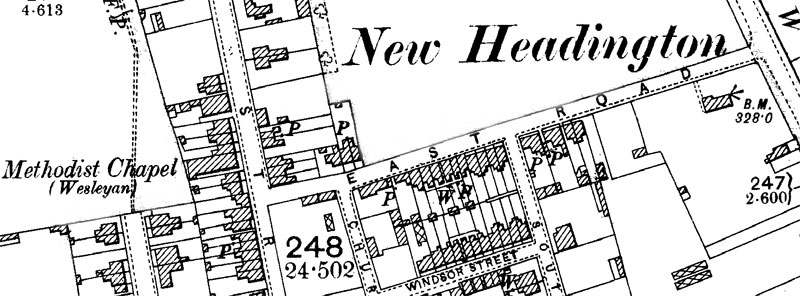
The above map shows Bateman Street (named EAST ROAD) in 1898, with Gardiner Street (named SOUTH STREET) and Perrin Street (named CHURCH STREET) running off to the south. Headington then had no piped water supply, which must have made life difficult for its many laundresses. The water supply in Bateman Street was then as follows:
- Four pumps, marked P, in back gardens: one shared by the present Nos. 20 & 22, one in the large house that has been turned around to face Perrin Street, and one each for Nos. 7 and 9
- Two wells, marked W, in back gardens, in the middle of the group of houses numbered 11–31.
North side of Bateman Street
The north side of Bateman Street had no houses at the time of the 1891 census: this is because the Latimer family of Old Headington (who sold the original L-shaped chunk of their land for the building of New Headington Village in the 1840s) retained for agricultural use the field bordered by London Road, Windmill Road, Bateman Street and the back gardens on the east side of New High Street.
Although this field was encroached on in the mid-1890s, with the building of Nos. 18, 20 and 22 Bateman Street, the rest of the north side of the street remained undeveloped until the 1920s, when the whole field was sold and Nos. 4–14 were built around the same time as Kennett Road.
In 1940 the six houses on the north side between Windmill Road and Kennett Road were named Westbury, Sunbury, Hatchford, Oakdene, Montrose, and Alma Vale, and the three older houses to the west of Kennett Rod were numbered 2, 4, and 6 East Road (now 18, 20, & 22 Bateman Street). When 16 Bateman Street was first built in c.1959 it was called New House. The north side of Bateman Street is first listed with its present numbering system in Kelly's Directory for 1960.
