


New High Street (formerly High Street, New Headington)
Former names of this street:
- South Hill (before New Headington village was built)
- High Street, New Headington (c.1852–1910)
- High Street, Highfield, Headington (1910–1929)
- High Street, New Headington, Oxford (1930–1940)
- New High Street, Headington, Oxford (1942–present)
This was the high street of New Headington village, laid out by William Mead Warner in 1852. This area was originally known as South Hill, and the name lingered until the end of the 19th century in the name ‘Southill Cottages’ (now Nos. 42–48).
- Photograph of New High Street in July 1967 (before the stone cottages at the SE end were rebuilt)
By the 1870s there was a grocer's shop at 24 New High Street, with a smithy behind. The map below shows the street in 1876:

In about 1880 a second grocer's shop was opened by Joseph Skey at 39 New High Street, and the smithy moved up to the yard of the Royal Standard.
In 1888/9 a Methodist Chapel was built in New High Street: it became the hall of Lime Walk Methodist Church when that opened in 1932.

The map below shows New High Street in 1898. Note how few houses had a well (W) or a pump (P):

The blacksmith James Rogers lived in New High Street, and the following advertisement of a forthcoming auction on 26 August 1871 suggests that he lived either at No. 62/64 or 74/76, as these were the only four cottages that had a well:
TWO FREEHOLD substantially-built Brick and Slated COTTAGES, each containing 4 rooms and offices, large Garden, well of capital spring water, and other conveniences, situate at New Headington, in the occupation of Messrs. Jacobs and Rogers, very punctual tenants, at the low rentals of £10 8s. per annum.
Headington Cinema (later the Moulin Rouge) opened at the top of New High Street in the 1920s:

In 1929, when Headington became part of Oxford, the enlarged city confusingly boasted no fewer than five high streets (in Highfield, Old Headington, Quarry and the St Thomas area – not to mention The High itself). In 1942 a sensible compromise was adopted, and the three Headington High Streets became respectively New High Street, Old High Street, and Quarry High Street.

On 24 March 1967 Princess Margaret opened All Saints' Church House in New High Street, which replaced the former hall made of metal. On 20 March 1970 Freddie Mercury (who then called himself Fred Bulsara) gave his debut performance at a Shelter Benefit Concert here with the band Sour Milk Sea
On 9 August 1986 New High Street gained international fame when the Headington Shark landed on the roof of No. 2.
Some of the larger houses to the north of New High Street
11–13 NEW HIGH STREET (NOW STONE RISE, FORMERLY HOPE VILLAS)
 In 1987 the above two houses flanking Stone Rise were built in its very wide garden (86/00967/NF)

Stone Rise was built in c.1860 as a pair of large semi-detached houses called 1 and 2 Hope Villas.
The extract from the 1876 map of Headington (right) shows the large gardens of this pair of villas. These gardens survived until c.1990, when an extra house was built beside on each side of the pair.
A forthcoming auction of this pair of houses was advertised thus in Jackson's Oxford Journal of 8 December 1866:
NEW HEADINGTON, OXON.
TWO FREEHOLD VILLAS, WITH LARGE GARDENS
Situate in a most healthy and pleasant part of New Headington. Each House contains two sitting rooms, four bed rooms, capital kitchen and cellar arrangements, with a large walled-in garden in the rear, and a flower garden enclosed with iron palisades in front, built in a most substantial manner, and now in the occupation of Mrs. Hinton and Miss Preedy,
At the time of the 1871 census only the servant was at home at 1 Hope Villas, but Miss Julia Preedy (32) and her sister Miss Harriet Preedy (31), who both had an income derived from lodgers and houses, were at home with their servant and two lodgers.
In 1891 Henry Philcox and his family lived at No. 1, and the widow Angelina Hough at No. 2.
In the early 1930s Hope Villas were converted into a single house by John Leonard Norman Baker (Lord Mayor of Oxford in 1964/5, and the father of Baroness Young).
15, 17, 19, & 21 NEW HIGH STREET (Fair View Terrace)

This group of four houses dating from the 1870s used to have an uninterrupted view over to Cumnor Hill, hence their name. They are named Fair View Terrace on the 1876 map above. Originally No. 15 was a stable and coach house with two rooms over, and was occupied by a cab driver. On 9 March 1878 the following advertisement in Jackson's Oxford Journal advertised all four properties for sale:
NEW HEADINGTON, NEAR OXFORD.
THREE newly-built FREEHOLD HOUSES [Nos. 17, 19, and 21],
a Stable, large Coach House, and Two Living Rooms over [No. 15],
the whole forming “Fair View Terrace,” New Headington;
TO BE SOLD BY AUCTION, By Messrs. GALPIN and SON,
At the Britannia Inn, New Headington, on Thursday March 21st, 1878,
at 6 for 7 o'clock in the evening.Lots 1, 2, and 3, are each a substantially-built Brick and Blue-slated DWELLING HOUSE; containing entrance passage, front sitting room (with bay window), back sitting room, and washhouse, on the ground floor, and three bed rooms on the one pair floor; a small Ornamental Garden, enclosed with iron fencing, in the front, and a very productive Garden and other conveniences in the rear, enclosed with brick walls. They are pleasantly situated in a very healthy locality, with an abundant supply of good water, and are in the several occupations of Messrs. Odey, Bryan, and Saunders, at a rental of £13 per annum for each House.
Lot 4.—A STABLE and large COACH HOUSE, with Two Living Rooms over, and enclosed Garden and other conveniences in the rear, the whole in the occupation of Mr. Winter.
23 NEW HIGH STREET (Woodman's Villa) — demolished in 1997

When this house was built in the 1860s, it was one of the finest houses in the village of New Headington. Most of the other houses built for the high-street gentry were only semi-detached (e.g. Nos. 13/15, 25/27, 2/4). The only equivalent detached house was No. 6, removed along with its orchard to make way for Alison Clay House.
No. 23 was originally called Woodman’s Villa, and is labelled thus on the 1876 OS map of Headington. It is first named in directories in 1869, when a Mrs Scarlett lived there with her two sons. Her husband, William Scarlett, had farmed Mather’s Farm in Old Headington until his death in about 1868, and his widow moved to 23 New High Street soon after. But by the time of the 1881 census, when her two sons had presumably left home, she was living in smaller premises at 17 New High Street with a young servant girl aged 11. No. 23 was now occupied by Joseph Rose, a retired publican, and his wife, who had moved from 25 New High Street next door.
In about 1889 a real woodman moved into No. 23 with his wife, daughter, grand-daughter, and servant, but ironically he changed its name to Dereham. He was Abraham Parker, formerly of Highfield Farm (then known as Parker’s Farm), a wood dealer and faggot merchant. He was responsible for introducing commercial activity to the premises, building the large warehouse in the back garden that can be seen on the 1898 OS map. He died in April 1900, but his widow carried on the business until 1904.
E. J. Douglas then ran a market garden at No. 23 from 1911 to 1923, growing his produce on the large field beyond his back garden; but the Kennett Road development on that field put paid to that.
From c.1929 to 1950 Thomas Nutt was a coal dealer on these premises.
From the early 1960s the site was used as a depot: first for St Ivel (taken over by Cow & Gate and in turn Unigate); then for Charles Woods Removals, Blackwells Removals, Austin Beds, and A-Mail/Clio Press; and finally for a coffee-dealer.
In 1997 the City Council granted permission for the demolition of the house and the industrial building behind (97/01104/NF), and six houses, known as Woodman's Villas, were fitted in to this site in 1998.
25 & 27 NEW HIGH STREET (Prospect Villas)
 This pair of semi-detached houses also dates from the 1860s.

31 NEW HIGH STREET
This detached house is one of the earliest ones built in New High Street.
It matches exactly two other houses, one in Bateman Street and one in Wilberforce Street.
Richard Westell (30), who was employed as a butcher, lived here in 1891 with his wife Fanny, a self-employed laundress, and their two young children.
Some of the smaller houses to the south of New High Street

78 NEW HIGH STREET
This house (right) is typical of the terraced cottages at the south end of the street.
Some of its original brickwork is showing. Nearly all the other houses in New High Street have had their brickwork covered with rendering.
59, 61, 63, & 65 NEW HIGH STREET
For the old cottages dating from 1853 opposite All Saints Road (now rebuilt),
see separate page
34 NEW HIGH STREET
Mrs Lucy Grain (shown below with her husband and eight children, plus one grandson) ran a thriving home laundry at 34 New High Street: see Laundresses of Headington page. She was born in Barton, and had moved with her family from there to 34 New High Street in about 1866. The Grains were well known in New Headington, with family members running the Butcher's Arms

Shops of New High Street
Whereas most people remember the cinema and shops that until recently existed at the top end of New High Street, fewer realize that before these were built in 1925, the shopping focus of the street was further south.
Before the 1890s, directories and censuses are very imprecise, so that all one can say with certainty is that in 1861 there was a ‘Shoemaker & Grocer’s shop’ somewhere in the street; in 1871 there were two shops (a Baker’s and a Grocer’s – the latter appearing to be at No. 27); in 1876 there was a Smithy behind No. 24; and in 1881 there were three shops (a Dairy, a Grocer’s, and a Baker’s).
In 1891, the picture is clearer: the census shows just two proper shops in New High Street, situated at No. 24 and No. 39. (One would have expected more shops in a village high street: but trade at this time was moving to the newly-built and therefore fashionable Lime Walk.) These two nineteenth-century grocer’s shops are still remembered by some local people: No. 24 was owned by Thomas Schofield (its proprietor for 40 years) when it closed down in the late 1950s, and No. 39 was owned by Mr Simms when it closed in 1973.
Other shops came and went. No. 17 was a tobacconist’s in 1925 and a grocer’s from 1927 to 1929; No. 18 was a fruiterer’s from 1923 to 1945; No. 23 was a faggot dealer’s from 1890 to 1900 and then a coal merchant’s until 1949; No. 27 was a dairy from 1912 to 1926; and No. 36 was a boot repairer’s from 1922 to 1940. Perhaps the most surprising is No. 50, which was a draper’s shop from 1901 to 1913 and a confectioner’s from 1919 to 1925. In addition to all these proper shops, there were plenty of self-employed tradesmen in the street, such as carpenters, chimney sweeps, laundresses, and tailors.
Headington Cash Drapery, 50 & 50A New High Street

In about 1900 Miss Frances Smith moved to her father's home at 50 New High Street (above left) and started a drapery business downstairs.
By 1911 (below) an extension on the left (now a separate house, 50A) had been built, enlarging the shop and providing extra accommodation upstairsfor her widowed sister and her three young children.
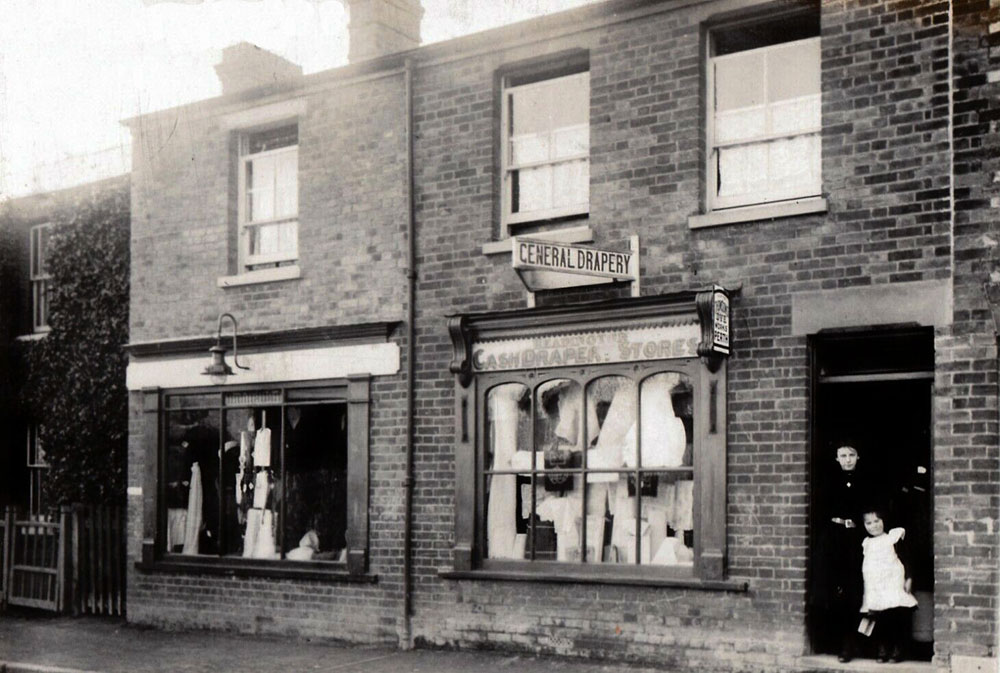
Miss Smith died in 1912.
Photographs of New High Street shops and businesses taken by the city council in 1957:
