


Pullen’s Lane: The Croft
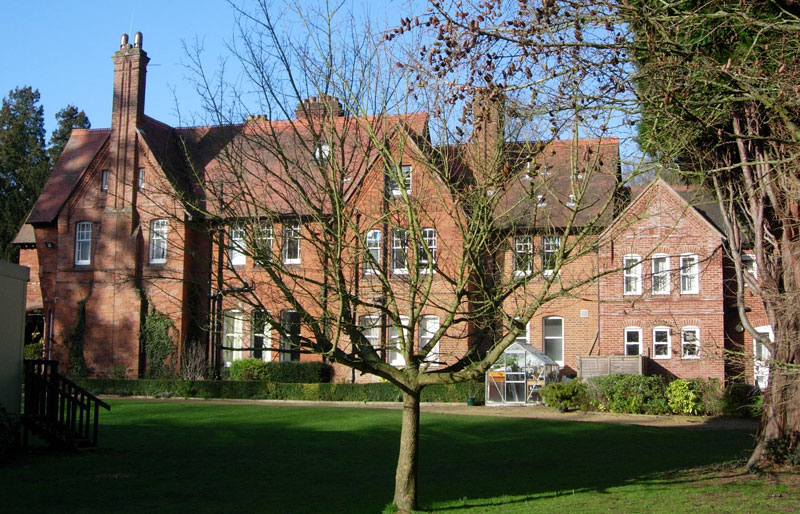
The Croft was built on the east side of Pullens Lane in 1881/2. It was the second large “don’s house” to be built in the lane, and at the time of the 1881 census was in the course of construction: it is listed as “Headington Hill (Mansion with coach house and stables adjoining): Being built”. Pevsner describes the house as “1880 by Waterhouse, redbrick, in Waterhouse-Gothic with straight topped windows”.
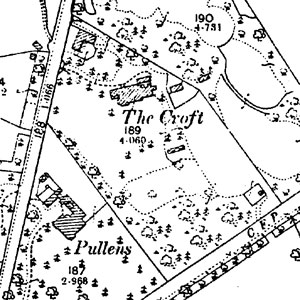
The map on the left dated 1898 shows how The Croft’s 12-acre grounds stretched from the east side of Pullens Lane to Cuckoo Lane. Its only neighbour then was The Pullens (1880), but In 1887 it was joined on the other side by Langley Lodge.
The Croft had its own lodge to the north-west: this was occupied by coachman Henry Wicks (60) and his wife Eliza (63) in 1911.
The Croft and Langley Lodge together now form Rye St Antony School. This school will join with Headington School to become Headington Rye in September 2024
The Willert family and The Croft, 1881–1945
The Croft was built for Paul Ferdinand Willert, who was a Fellow of Exeter College, Oxford from 1867 and also a barrister-at-law at the Inner Temple from 1870. He vacated his fellowship when he married Henrietta Crofts, daughter of John Crofts, at her family home of Adel near Leeds on 5 July 1881, but was re-elected in 1882. His widowed mother Susan Preston Willert lived at the Croft with him, and on 19 November 1881 at St Andrew's Church at the age of 71 she married Sir Joseph Heron of Rookswood, Broughton Park, Manchester.
Willert's son Arthur was born in Oxford on 19 May 1882 and baptised at St Andrew’s Church, Headington on 1 July, and their daughter Dorothy was born there three years later. At the time of the 1891 census, Paul and Henrietta Willert were not at home in the Croft, but their two young children were there, looked after by four servants. The Willerts also had a coachman, Henry Wicks, who lived with his wife in the lodge of The Croft.
At the time of the 1901 cenus Paul Willert (described as “Formerly College Tutor” and aged 56) was at home with his wife Henrietta (49) and their daughter Dorothy (15). They have five servants (a housekeeper, housemaid, under-housemaid, cook, and parlourmaid) living with them in the house, with the same coachman still in the lodge.
Paul Willert died in 1912, and Mrs Willert remained at the Croft until her own death at the age of 65 in 1918.
After that date the house was let out by Paul Willert's son Arthur Willert. He was the chief U.S. correspondent for the Times of London from 1910 to 1920. He also served as the secretary of the British War Mission in Washington in 1917–1918 and was knighted in 1919 for valuable services in connection with the War.
Sir Arthur Willert let the house out to James C. Robertson in 1922, Leama R. Davies in 1923, and Bernard Wardle in 1925/6.
From 1928 to 1945 the house appears to have occupied by Sir Arthur Willert, KBE himself. He was head of the Ministry of Information Office for the Southern Region from 1939 to 1945 and was the author of four books on politics, and other writings. He sold the house in 1945, and died in March 1973 at the age of almost 91. He had one son, Paul Odo Willert, born in 1909.
Part of Rye St Antony School (now part of Headington Rye School), 1945–present
Rye St Antony School, which had moved to Langley Lodge next door in 1939, bought the 12-acre site of The Croft and its lodge and joined the two sites.
