
Postcard order for ink for the Rookery School

This postcard was franked twice: first on the left-hand side at Headington Post Office, and then again at the top in Oxford (with the number 605 that obliterates the pre-printed postage stamp being the reference number of Oxford Post Office). The date of both frankings is obviously 2 July, but the year is harder to read..
On the back is this order below sent by W. S. Gibson of The Rookery (now Ruskin College) in Old Headington to M. A. A. Mathews, stationer of St Giles'.
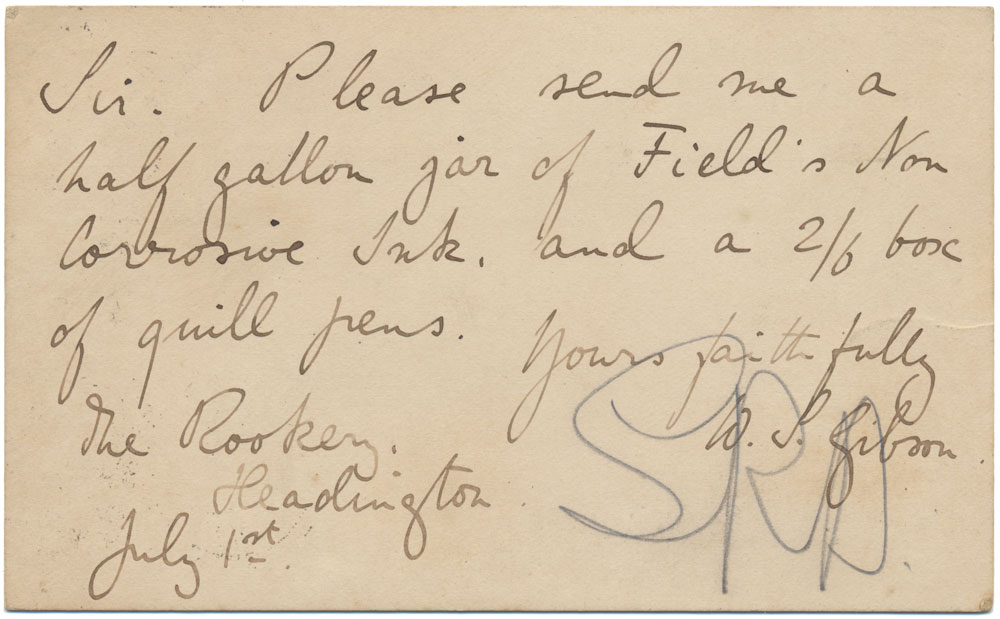
The above message reads:
Sir. Please send me a half gallon jar of Field's Non Corrosive Ink, and a 2/6 box of quill pens.
Yours faithfully
W. S. Gibson
The Rookery, Headington
July 1st
Walter Sumner Gibson (1849–1918), the sender
Gibson, who had been an undergraduate at Balliol College, bought The Rookery in Old Headington (then being used as a boys' prep school) from the Revd Taylor in 1883. He married Julia Elizabeth Olivier the following year, and their six children were born at the Rookery between 1885 and 1897. The half a gallon of ink (four pints, or 2.27 litres) that he ordered in 1885 was obviously for school rather than personal use.
He then worked as schoolmaster and later a tutor in London, but moved back to Oxford and lived at 9 Lathbury Road after being appointed academic reader to the Oxford University Press in 1914.
His son Harry Olivier Sumner Gibson served in the First World War and was killed in Palestine on 19 April 1917. There is more detail about Gibson and his family in Harry's war biography.
Walter Sumner Gibson died on 20 January 1918 at 9 Lathbury Road. His effects came to £515 19s. 4d., and his wife Elizabeth was his executor.
Michael Angelo Alfred Mathews (1821–1901), the recipient
M. A. A. Mathews, the stationer to whome the postcard was sent, is listed in Kelly's Directory from 1891 to 1894 as a “stationer, printer, bookbinder &c” at 69 St Giles' Street (one of the shops demolished in 1937 to make way for the second phase of the Taylorian).
Plain postcards
Plain postcards with no picture were first issued in the UK in 1870: they were published by the Post Office, and they all had a pre-printed stamp as in this example. (No other companies were permitted to print postcards until 1894, when they started to appear with pictures.) These plain postcards were used for business correspondence: they saved money, as the postage rate was a halfpenny, as opposed to a penny for a letter, until 1918, when both rates were increased.
