


New Headington Infants’ School
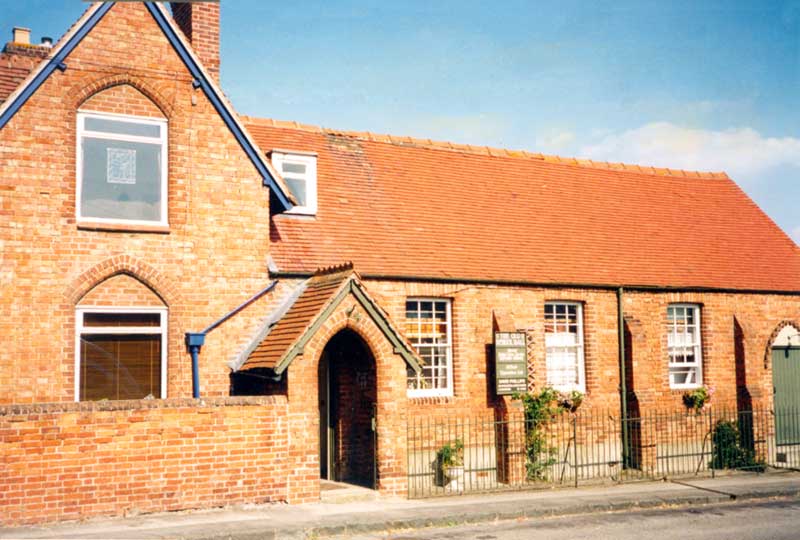
The above building in Perrin Street (formerly Church Street) was New Headington Infants’ School from 1873 to 1908.
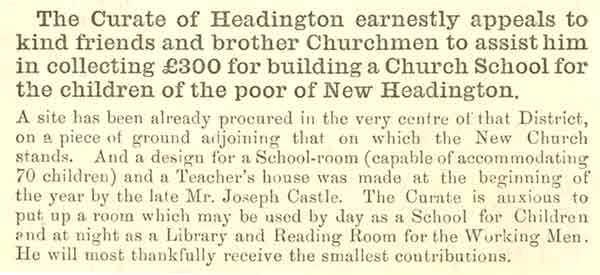
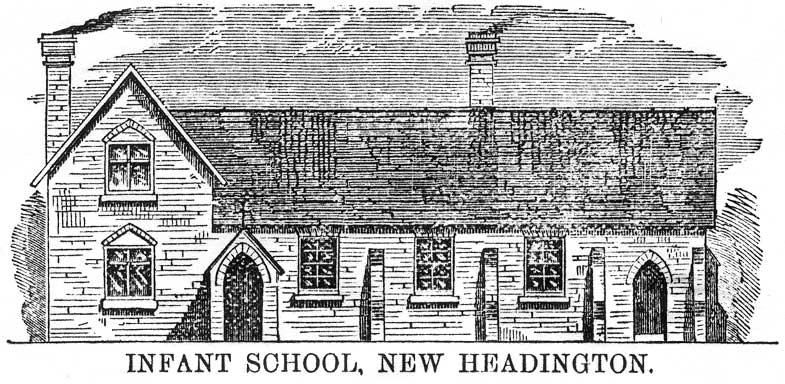
The above appeal by the curate of St Andrew’s Church (Lewis Stacey Tuckwell) for funds for building a church school for the children of the poor of New Headington village appeared in the Headington Parish Magazine of December 1872, and the drawing below, made by Joseph Castle, appeared in the May 1873 edition.
From 1852 to 1873, the young children of New Headington village attended Old Headington Infant School in North Place. But by 1872 New Headington village had grown enormously and was already nearly as big as Old Headington, and the old school could no longer accommodate all the infants of Headington and Barton.
Appeals were made in the Headington Parish magazine to raise money for a separate church infant school for New Headington, and by May 1873 contributions ranging from six shillings from “Nesta” to £10 from Miss Watson Taylor of the Manor House came to a total of £52 12s. By July the building fund had risen to £134 10s. 10d., including £50 from “A Friend in Oxford” and £20 from Magdalen College (then the principal landowner in Headington). By the end of October 1873, contributions had reached £206 13s. 9d, and by May 1874 £253 8s. 0d.
On All Saints Day (1 November) 1873, New Headington Infant School was opened by the Bishop of Oxford (John Fielder Mackarness). Following a morning service at 11am in St Andrew’s Church the Bishop, the Clergy, and the Choir walked in procession over to the school in New Headington, where another short service was held, and then the Bishop opened the school “to the glory of God, and for the education of the young of this part of this Parish in his Faith and Fear”. They then processed back to Bury Knowle House for luncheon with Mrs Ballachey.
A notice in the parish magazine for November 1873 stated: “Children resident in New Headington, who have not completed their seventh year, will be admitted to this School on Monday the 10th, at 9 o’clock. The charge for each child will be one penny weekly.” Jackson’s Oxford Journal was rather behind with the news: nearly a year later, on 24 October 1874 (p. 7c) it reported as follows:
A new infant school has recently been built at Headington by Messrs. Castle, Cowley-road, from designs prepared by the late Ald. Castle. The building is 37 feet long by 17 feet wide, and, together with a house for the teacher, cost 350l.
Alderman Joseph Castle (Mayor of Oxford in 1868/9) had made his name as a builder when he built Headington Hill Hall between 1856 and 1858, and by the time of the 1871 census his firm was very large and he employed 127 men.
The school was designed for 100 children aged between three and six. After their sixth birthday the children who attended this school moved up to Headington National School (now St Andrew’s Primary School) on the London Road.
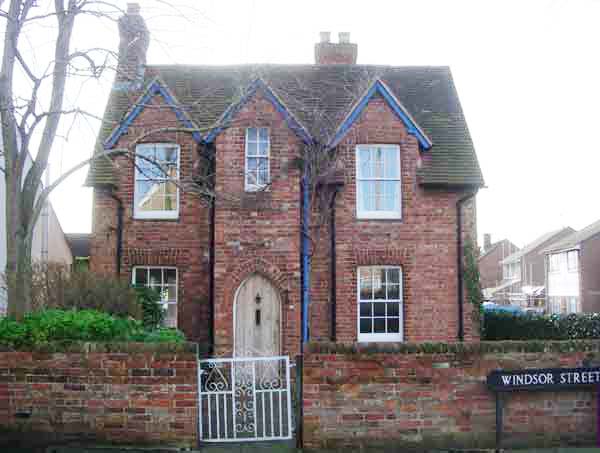
The Mistress of the Infant School lived in the adjoining school house, which faces on to Windsor Street: the right-hand side of the house can be seen on the left of the above engraving and photograph, and the front is shown below.
The parish magazine reported at the end of November 1873 that New Headington School
has begun well. Children were first admitted on Monday, 10th, and since that day there has been an attendance of between 60 and 70 infants. It is proposed to open, as soon as the New Year begins, a Sunday School for the children resident in New Headington, and in connection with it a Sunday Lending Library.
The fees for this infant school, published in the Oxford Times of 13 October 1877, were as follows:
- Class I: Farm labourers and all whose usual weekly earnings (not including harvest work) do not exceed £1:
2d a week for the first child, and 1d for every other child - Class II: All those whose usual weekly wages or earnings are above £1 (except such as come under Class III:
3d for the first child, and 2d for every other child - Class III: All persons assessed to the Poor-Rate at or over £10:
4d for every child.
In 1880 schooling became compulsory for children aged 5–10, but the parents still had to pay fees.
The log books of Headington National School indicate that the academic standard of the new infant school did not match the fine new building: for instance the Mistress of the girls’ section wrote in 1883:
Admitted twenty-five children from the Infant Schools on Monday and Tuesday – three for Standard II, the remaining twenty-two for Standard I. The children from Old Headington are well up in their work – those from New Headington are behind.
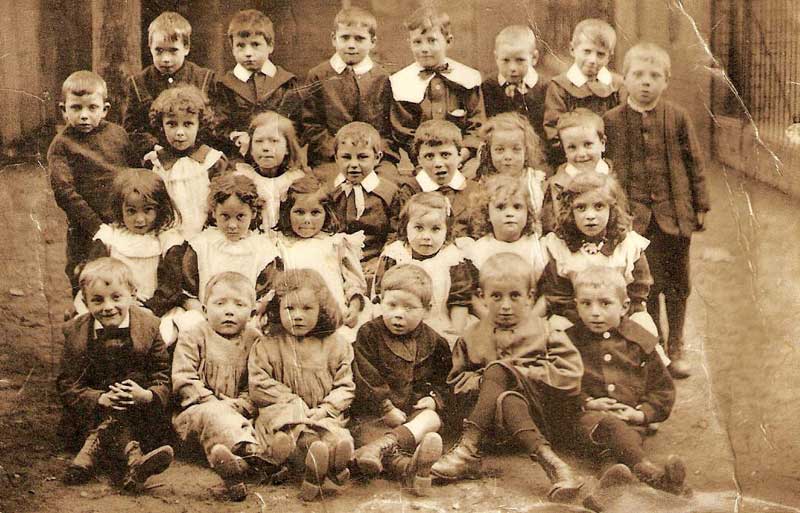 A class at New Headington Infant School in 1906
After only 35 years, the school closed in 1908 when Headington’s first council school opened in Margaret Road, and its Mistress Mrs Price (formerly Miss Atherton) transferred with the children. The old building was then used for many years by Headington’s Guides and Brownies, and then by various commercial firms into the twenty-first century.
In August 2015 the following joint planning application for the school (now numbered 6 Perrin Street) and the teacher’s house (now numbered 18 Windsor Street) was approved (15/01778/FUL):
Subdivision of existing building and erection of two storey side extension to form 2 x 2bed flats (Use Class C3) and 1 x 3bed dwelling (Use Class C3). Formation of 2No dormer windows and insertion of 4No rooflights. Erection of porch to South elevation. Insertion of windows and door to North elevation. Provision of car parking spaces, bin and cycle storage and private amenity space.
A second planning application seeking to remove condition 12 of the approval was submitted in November 2016 to enable the conversion of the garage into habitable space (16/02863/VAR).
The school building with the teacher's house were both added to Oxford City Council's Heritage Asset Register in 2018.
