


The Free School at Quarry
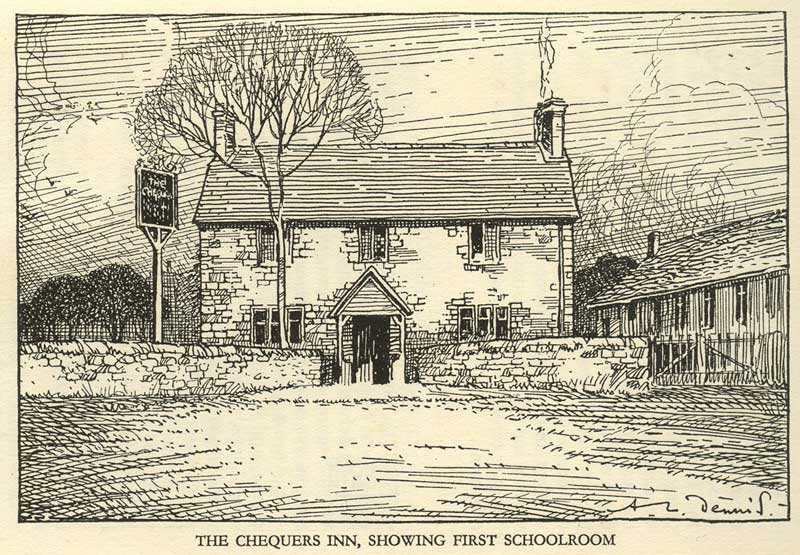
The first free school for the children of Headington opened in 1807 in a wooden building next to the Chequers Inn in Quarry. Until 1849 Quarry was an outlying part of the parish of St Andrew’s Church, and the school served the whole of that parish, from the top of Headington Hill to Sandhills.
The engraving below, dating from around 1820, shows how close the school was to the quarry to the east.

Headington can thank Miss Catherine Mather for its first free school. She was the daughter of the Revd Dr John Mather, President of Corpus Christi College from 1714/15 to 1748, who leased Mather’s Farm in Headington. She died in Headington on 12 March 1807, leaving money to the Vicar and Churchwardens of St Andrew's Church to found this school, as this wooden board fixed to the south wall of the Baptistry of the church states:
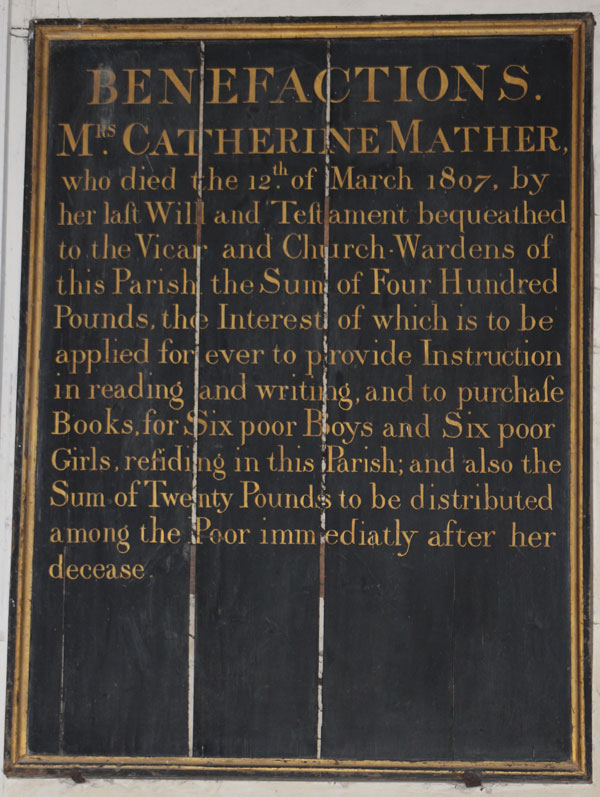
It reads:
BENEFACTIONS.
Mrs. Catherine Mather,
who died the 12th of March 1807, by her last Will and Testament bequeathed to the Vicar and Church-Wardens of this Parish the Sum of Four Hundred Pounds, the Interest of which is to be applied for ever to provide Instruction in reading and writing, and to purchase Books, for Six poor Boys and Six poor Girls, residing in this Parish; and also the sum of Twenty Pounds to be distributed among the Poor immediatly after her decease.
Almost immediately St Andrew’s Church itself started to pay for the education of another 18 Headington children: in a letter dated 29 April 1808 the Vicar of Headington wrote to the Bishop of Oxford saying that the Free School ikn Quarry “consists of 30 Scholars, 12 of whom are supported by a legacy of the late Mrs Mather amounting to £20 per annum, the remainder I pay for myself.”
When Headington National School opened on the London Road in 1847, the church transferred its financial support there, and the Free School in Quarry continued with just the original twelve Mather scholars.
The Master of the Free School from 1828 until he died in 1874 at the age of 88 was James Waring, a man of humble origins: he had been a milkman in 1825 and a labourer in 1826. As well as being schoolmaster, from the 1840s until his death he was also Headington’s postmaster. The school closed immediately when he died, and an impressive gravestone was placed in St Andrew’s churchyard by “some of the inhabitants of Headington” as a sign of their esteem and gratitude to him.
Despite Mrs Mather’s desire that the money should educate Headington’s children “for ever”, the money, which had been invested in canal shares, dwindled away. It was used to fund prizes at Headington National School from 1874 to 1902, and then vanished.
