


The Butchers’ Arms

The Butchers’ Arms at 5 Wilberforce Street (formerly William Street) was the beerhouse for the village of New Headington, which was laid out in 1853. On 27 May 1854 the forthcoming auction of seven newly built houses in New Headington was advertised in Jackson's Oxford Journal, including the following, which may be this pub:
Lot 2.—TWO HOUSES, in the occupation of Mr. Snow, used as a Public House, and containing two sitting rooms, tap room, four bed rooms, and back kitchen, with garden.
This pub was certainly licensed as a beerhouse prior to 1869, and in the 1871 census William Bleay was the beerhouse keeper here. From the mid-1870s it was sometimes described as an inn.
A butcher took the pub over in 1876, and the first mention of the present name of the pub was on 3 August 1878 in Jackson's Oxford Journal, when two freehold cottages and an adjoining paddock were described as being “situated near the Butcher's Arms”.
Inquests were usually held at pubs in the nineteenth century, and on 25 December 1880 Jackson's Oxford Journal reported on one held at the Butcher's Arms into the death of a two-year-old child called Frederick Charles Eaton of Shotover Prospect in Gardiner Street who suffered burns after falling on a smoothing iron that had been left on the floor.
In Valters' Directory for 1890, the words “Hanley's Entire” appear after the name of the pub, showing that it was now tied to Hanley's Brewery.
Abortive plan to move the Butcher's Arms in 1894On 1 September 1894 Jackson's Oxford Journal reported that at the County Brewster Sessions held at County Hall on 25 August, the solicitor Mr Mallam, acting on behalf of Messrs Hanley, the owner's of the Butcher's Arms, made an application for permission to remove the licence of that house to more suitable premises to serve the 226 occupied houses of New Headington village. The architect Mr Quinton said he had prepared a plan of the suggested new premises, which would be on New High Street, where there was room for a considerably larger pub with about an acre of ground around it. It was said that the building in Wilberforce Street, which then had just two rooms up and two down with a cellar on the ground floor, was now extremely inconvenient for carrying on business. Abraham Parker of Woodman's Villa in New High Street spoke in favour of the move, saying the proposed house would be a great convenience, and add much to the beauty of the street. He added that the current landlord of the Butcher's Arms [James Young] was one of the most industrious men he had ever known, and had never heard of any disturbance in his house. Mr Ballard spoke against it on behalf of the trustees of the Wesleyan Chapel in New High Street, which was exactly opposite the proposed site, saying that the Sunday School was attended by about 120 children, and a Band of Hope was held there. John Roff, parish clerk of New Headington, said that he had canvassed local property owners and ratepayers, and most were against the proposal. The application was refused. |
On 3 August 1895 Jackson’s Oxford Journal reports on an inquest held in the Butcher’s Arms on a child who died in New High Street.

The 1898 map of Headington (left) shows the beerhouse as a large building on the north side of Wilberforce Street (which was originally named William Street but renamed in 1959 to avoid confusion with two other William Streets in Oxford).
The beerhouse evidently had to get its water elsewhere, as unlike nearby properties it is not marked with W (for Well).
Opposite to the pub is the row of mean cottages known as Mattock’s Row, and behind them the greenhouses of the nurseries of John Mattock.
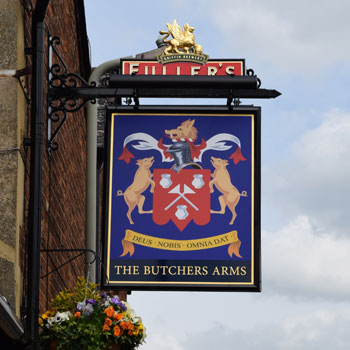
The inn sign (right) is a porcine parody of the armorial bearings of the Butchers’ Company:
- The shield has a cross of two curious funnel-shaped objects instead of the usual silver butchers’ poleaxes
- Moneybags have been substituted for the usual butcher’s broom
- A winged boar’s head has been substituted for the usual “bull statant with wings addorsed” as the crest on top of the helmet
- The supporters are two pigs rampant instead of the usual bulls
The motto “Deus nobis omnia dat” (“God gives everything to us”) is of unknown origin, and is not that of the Butchers' Company.
Early landlords
- Possibly Mr Snow, 1854
Named as occupying a public house in New Headington on 27 May 1854. - William Bleay, 1869–1874
The first landlord definite landlord of the pub was William Bleay, who in the 1850s had been a beer retailer in Old Headington but later turned to dairying. He is listed in the 1861 census as a dairyman in the Croft in Old Headington, but by 1869 had moved over to this New Headington pub. In the 1871 census Bleay is described as a “beer-house-keeper” and listed immediately after Silman’s Row (later known as Mattock’s Row, on the south side of Wilberforce Street). He did not stay long, however, and moved to New High Street and a general labouring job in about 1875. - James Young, 1876–1904
James Young then took the business over, and was probably better able to make a go of it because he was also a butcher. He is probably responsible for the pub’s name: the first reference to it is in the 1881 census, where Young is described as a “Journeyman Butcher & Innkeeper” at the “Butchers’ Arms Inn”. He remained as landlord until his death in 1903, and then his wife took over for a year or two.
- The Grain family, 1906–1970s
1906–1927: Thomas Grain
1927–1952: Mrs Ada Grain
1954–1970s: Bernard W. Grain
The 1911 census shows Thomas Grain (38) described as a licensed victualler, living at the Butcher's Arms with his wife Ada (37), who assisted in the business, and five of their children: Harold (13), Ernest (11), Florence (6), and Dorothy (1), plus a general servant. Their eldest son Harold Grain was killed in the First World War in 1917, aged 19 years.
In 1921 Thomas Grain (49) was described as a clicker for a legging manufacturer at 11 Queen Street and was living here at the pub with his wife Ada (47) and three of their children: Ernest (21), who was a National Insurance clerk working from home, Florence (16), and Bernard (8). Thomas died at the pub on 31 July 1927 at the age of 55 and was buried at Headington Cemetery.
His widow Mrs Ada Grain took over the licence of the Butcher's Arms on her husband’s death. In the 1939 Register she was described as a beerhouse keeper and was living at the pub with her son Bernard (27) who then worked at Morris Motors, and her son's wife Barbara and their two children. Mrs Grain continued running the pub for another 26 years until her own death at the age of 79 on 9 March 1953. Her son Bernard and his wife Rose then took over the pub until 1977.

Above: Thomas Grain at his family
home
(34 New High Street) in the 1890s.
At this time he was a bootmaker on the
London
Road, but in 1906 he was to
become landlord
of
the Butcher’s Arms
Right: Bernard and
Rose Grain
(née Hawes)
when they retired and left
the Butchers Arms
in 1977

