


Slade Camp/Slade Park
See also Old Road Prisoner-of-War camp
which also housed homeless people after the Second World War
During the Second World War a large part of what is now Brasenose Wood and part of the present Magdalen Wood were used by the army as “Infantry Training Centre No. 15”, which had a big collection of army huts around a parade ground and came under Cowley Barracks.
Before the eastern bypass was cut through the woods in 1960, and the two woods were different in layout: more information here. Today the bypass divides the city of Oxford to the west and Horspath parish to the east, and Magdalen Wood East is sometimes loosely described being part of Brasenose Wood.
The army training centre was known as Slade Camp, but when homeless families moved into the huts after the Second World War it became known as Slade Park. (Today the name Slade Park is still used, but only for the housing development to the east within the city boundary.)
The main entrance to the army camp was then at the far end of The Slade opposite the Corner House pub. (At that time The Slade became Hollow Way without turning into what is now Horspath Driftway, except for access to the Slade Isolation Hospital, which no longer exists.)

Almost at the south end of The Ridings is the above pillbox, which marked the rear entrance to the army camp.
The camp occupied an L-shaped piece of open land to the south of Magdalen Wood (then known as the Open Magdalen) and to the west of Brasenose Wood, shown on the 1880 map below. The present Eastern Bypass runs roughly along the route of the old Roman Way marked with a dotted line on that map:

The aerial photograph below (Historic England EAW003901) shows the L-shaped Slade Camp in 1947, viewed from the opposite direction:
See also archived version of Dereliction in the Shires: Slade Camp, Oxford
In his memoirs, the police officer Alan C. Dent wrote, “The Barracks of the Oxfordshire and Buckinghamshire Light Infantry were in Hollow Way and a short distance up the road in The Slade was Slade Camp, which was a large area of wooden huts around a parade ground. Gypsies also moved on to the site and for many years there was considerable friction, very often leading to violence.”
On 4 April 1946 the NAAFI building at No. 2 Disembarkation Unit, Slade Camp, together with its cinema and sleeping quarters, were destroyed by fire.
On 16 August 1946 the Daily Mirror reported under the heading “Squatters try to edge Army out” that families were attempting to occupy empty huts in Slade Camp.
In its annual report in 1949 the Oxford Preservation Trust reported that the threat to turn Shotover into a “small Aldershot” had been averted and that a proposal to retain the Slade Camp as permanent quarters for the regular army had been abandoned.
This map of Magdalen Wood and Brasenose Wood in 1900 side by side with the area today shows how the eastern part of Magdalen Wood and Brasenose Wood now appear to be the same wood, with the area that was once part of Slade Camp now full of trees.
Slade Camp becomes Slade Park
From 1948 homeless people were moved by Oxford City Council into the disused army huts. Although these huts are long gone, the Eighth and Ninth Avenues and the eastern part of the First and Fourth Avenues still exist in Brasenose Wood to the east of the bypass and are marked on this current map.
- The Oxford Sausage: Trevor Joseph and Slade Camp (including excellent photographs and plans of the camp)
Trevor's family moved into Fourth Avenue soon after the eastern bypass was built in 1959)
To the west of the bypass, in January 1977 the former Second Avenue was named Pickett Avenue and the former Fifth Avenue Peppercorn Avenue.
The first family to move into Slade Park in November 1948 were the Brechins at 102 Fourth Avenue. The army was then still on site making the huts habitable, and here Robert Brechin describes how the early inhabitants lived in just a single room, and a describes a meeting with Lady Townsend which led to the creation of two or three bedrooms in each hut.
On 17 May 1950 planning permission was granted for twenty pairs of Hawksley aluminium bungalows at Slade Park (50/01232/A_H).
See the Oxford Preservation Trust film: Into the Woods: The Slade Camp Story
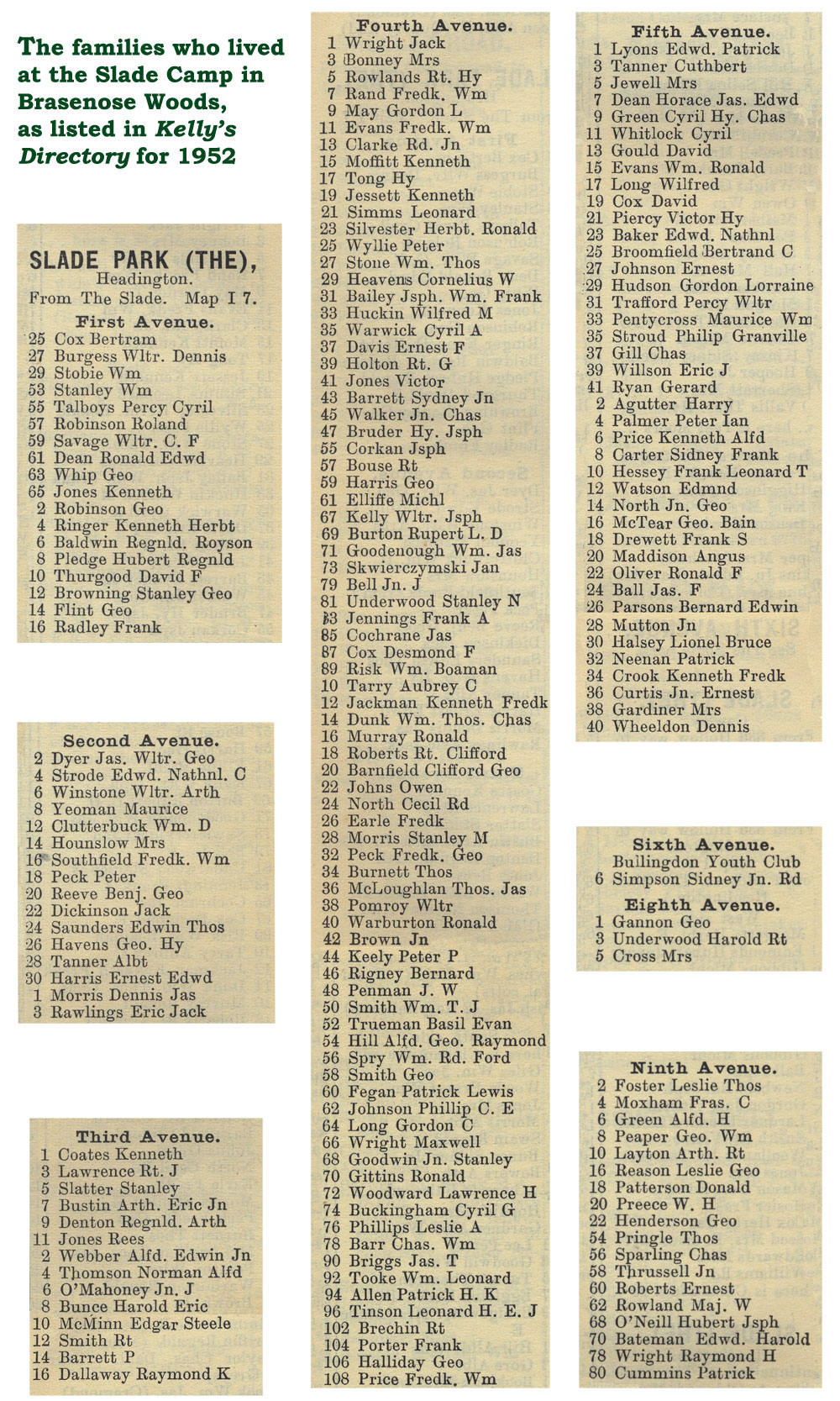
In 1959 work began on the Eastern Bypass, which cut Slade Camp into two. All nine avenues of the camp were still listed in Kelly's Directory for 1960, but the following year the huts began to be demolished.
When the boundary between Oxford and Horspath changed in the 1960s, Slade Camp was taken out of the city, and is listed under Horspath in Kelly's Directory for 1967 and 1968.
Inhabitants of Slade Camp listed under Horspath in Kelly's Directory for 1968 |
||
First Avenue 2: Gough, William 51: Giles, Norman |
Fourth Avenue 31: Krygier, M. D. 46: Massingham, Ronald |
Sixth Avenue6: Hobbs, William A.
|
The part of the camp to the west of the bypass was completely redeveloped in the 1970s and kept the name Slade Park, but the part to the east is still part of the woods.
 The avenues of Slade Camp still survive in Brasenose Wood,
but they are now lined with trees instead of army huts
In 2025 the Oxford Preservation Trust and the Shotover Preservation Society were awarded a £49,204 grant from The National Lottery Heritage Fund to uncover memories of life at Slade Cemp:
- Oxford Preservation Trust: Slade Camp
- BBC News: Army housing site memories project receives grant
- Facebook: Friends of Slade Camp/Park

The Savage family from London
at 59 First Avenue, Slade Park
Lyndon Savage records how on 17 October 1940 his grandparents Walter Charles Frank and Lilly Savage, with their eight-year-old son (his father) spent the night in their Anderson shelter at 13 Leonard Road, London E6. When the all-clear was sounded in the morning, they discovered that their house had been hit, as well as the nearby Toblerone factory where Walter Savage worked.
They pushed some salvaged items in a wheelbarrow to the Woolwich Ferry, and when bombing started they sheltered in a stranger’s house. They then walked to Brighton where they had relatives, still pushing the wheelbarrow: their son had to walk with bare feet as he had been in too much of a hurry to get to the shelter to look for his shoes.
They were evacuated to 5 Fern Hill Road in Cowley on 15 June 1943, and in September that year received £121 12s 6d to compensate for the loss of their “private chattels” in the bombing. They continued to be listed at that address in Kelly’s Directory up to 1947.
On 14 October 1949 they were moved to 101 Slade Camp in Cowley, and then on 27 April 1951 to 59 First Avenue, Slade Park.

In 1956 they bought a house in Warwick Street, east Oxford. Walter Savage worked at Pressed Steel in Cowley for the rest of his life, and retired to Haddenham.
See also
Martin Ferguson's memories
of living at the Slade Camp and then at Wood Farm
Woolley, Liz, Into the Woods: Memories of Slade Camp and Slade Park, Oxford 1948–1970
(Shotover Preservation Society and Oxford Preservation Trust, 2026)
The Oxford Mail has published a number of reminiscences about life in Slade Camp:
- 31 January 2011: “Happy days living at Slade camp”
- 4 April 2011: “Family were Slade Camp pioneers”
- 27 February 2012: “Shared story of camp life”
- 18 August 2014: “We shared hut at Slade camp”
- 5 October 2020: “Looking back: Army huts became family huts at The Slade camp”
- 3 March 2024: “Memories of Slade Camp in Headington after the war”
- 30 March 2024: “Walkers remember childhood days in the woods at Slade Camp”
- 12 May 2024: “Ice cream van brought treats for children at Slade Camp”
- 24 June 2024: “Fond memories of Slade Camp after the Second World War”
- 21 July 2024: “Memories for families living at Slade Park camp”
- 29 September 2024: “Memories: fire destroys hut at Slade Camp in Headington”
