


Four listed boundary/mileway stones
Headington Mileway stone
One use of the word “mileway” was unique to the city of Oxford, and the Oxford English Dictionary definition 3 for that word reads: “Any of the roads lying within a mile of the centre of Oxford, which were maintained with a contribution from local villages”.
These mileways stretched for one mile on the roads leading out of Oxford: north from St Giles’ Church, south from Folly Bridge, east from Magdalen Bridge, and west from Osney Bridge. They were marked with stones, but only two survive: one by the Old London Road in Headington (below) and the other on Rose Hill (an alternative route to London via Henley).
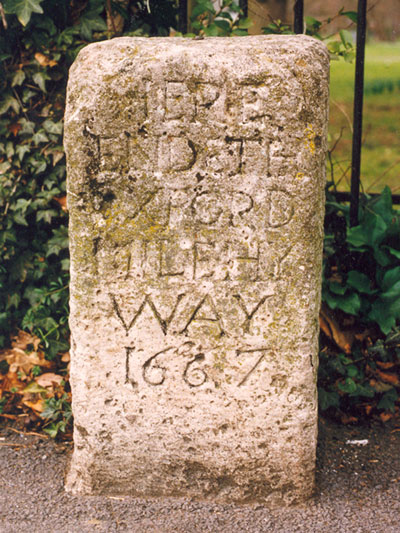
H E R E
E N D E T H
O X F O R D
M I L E H Y
W A Y
1 6 6 7
On the north side of Warneford Lane, roughly half-way between Cheney Lane and Gipsy Lane
This boundary stone was erected on the Old London Road in 1667.
The present London Road did not then exist, and the main highway to London was via Cheney Lane, Old Road, and Shotover, so this stone was on a major road out of Oxford. .
This stone is one mile from Magdalen Bridge, rather than from the East Gate of the city, which was not taken down until 1771.
List entry for highway stone
in Cheney Lane: 1369693
There is also a benchmark on this stone
On 9 December 1689, 22 years after the above stone was set up, the Oxford Council Acts recorded that the mileway supervisors were going to be sued for not keeping this mileway in good repair::
The Mayor and his brethren and the recorder are empowered to treat with the Vicechancellor and to deposit any sum not exceeding £20, the University laying down the same sum, for the defence of the supervisors of the mileway eastwards who are sued by Mr. Pudsey for not repairing Headington Hill
As the present road known as Headington Hill only led up to fields and footpaths until the end of the eighteenth century, this presumably refers to the lower part of the road and Cheney Lane as far as the above stone.
After the Oxford Mileways Act came into force in 1771 the old Oxford mileway stones became redundant, and in any case very soon after that date the new London Road was cut through the fields of Headington.
Boundary stone in Barton

T. W.
1 6 8 4
This boundary stone stands in the field to the east of Lower Farm and separated the former Barton Farm from Wick Farm. It is opposite the bottom end of Barton Village Road before it swings right, across a small ancient stone bridge. It is adjacent to the north side of the Bayswater Brook, roughly in the centre of this map, which shows the area both at the end of the nineteenth century and today.
Next to it are two other stones, one of which appears to be an ancient gatepost.
List entry for boundary stone
in Barton Village Road: 1485757
Christ Church & Dorchester Residential Management bought this field from the Oxford Preservation Trust in 2021 and this stone is in the path of the bus route they plan to run through it to their new develpment. On 30 May 2023 they submitted planning application P23/S1832/LB to South Oxfordshire District Council seeking to relocate the stone, but withdrew the application in September 2023.
When this stone was set up in 1684 the Whorwoods were Lords of the Manor of Headington, and the letters T. W. on this stone are likely to stand for Terra [land] Whorwood, marking the boundary between the manorial land and Wick Farm. It also appears to stand on a much earlier boundary of 1298 between the Manor of Headington and the Forest of Shotover.
Until 1881 the boundary of Headington curved north to include Barton Farm and Wick Farm. It was only in that year that the boundary was moved southwards down to the Bayswater Brook, but although this land thenceforth came under Stowood (now Beckley & Stowood), it continued to be considered part of Headington.
Headington highway stone
This marks the boundary of the villages of Headington and Marston and the parishes of St Andrew's and St Nicholas's Church.
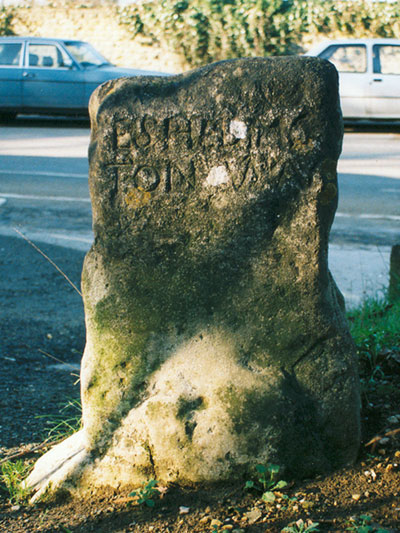
[H E R E E N D]
E S H E D I N G
T O N W A Y
At junction of Cuckoo Lane and Marston Road
Cuckoo Lane runs down to Marston Road via a footpath behind Headington Hill Park.
Before 1800, this was an important route to Headington village from Marston, which explains the position of this stone. It stands at the end of this narrow path, just by the Marston Road, and is designed to be read as the traveller left Headington.
It stands on the line of the old boundary of Headington, and probably dates from the seventeenth century.
Listed entry for highway stone
at end of Cuckoo Lane: 1046587
Headington highway or mileway stone
This stone is at the side of a main road with no pavement, so it is not safe to visit it, and today it can only be seen by cyclists travelling up the hill.

H E R E E N D E T H
H E D I N G T O N
H Y W A Y
W.K. J.F.
In north side of wall of Headington Hill, just 20 yards above the bridge.
This stone probably dates from 1729, as WK and JF are the initials of William Kenton and Jeremiah Franklin, who in 1728/9 were respectively Senior Bailiff and Mayor of Oxford.
When this stone was set up, this road stopped at the top of Headington Hill: the main route from Oxford to London turned off half-way up the hill to Cheney Lane and Old Road, while those wanting to go to Old Headington would ascend the road to the top and then take a route roughly along the line of Cuckoo Lane to the left.
List entry for highway stone
on Headington Hill: 1184684
The stone is set into the retaining wall of the raised footpath up Headington Hill that had been created in about 1700. It probably stood on the road originally (although it may have been moved when the road was realigned in 1771), and it was set into this wall during road improvements in 1930.
The meaning of this stone is unclear. At first sight it appears to be a boundary stone, set up by Headington to mark the end of the parish (rather like the above boundary stone at the bottom of Cuckoo Lane). But if that is the case, it is strange that it bears the initials of the Mayor and Senior Bailiff of Oxford, especially as the boundary near this point was not even with Oxford (which then only stretched as far as Magdalen Bridge to the east), but with St Clement's (which extended up to near the top of Headington Hill and was not taken into the city until 1835).
Other Headington boundary stones that are NOT listed
These are recorded here for completeness.
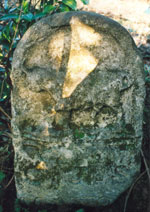

Left This boundary stone in Cuckoo Lane, below the junction with the path leading to John Garne Way, probably dates from before 1868, when 216 acres of Headington near the top of Headington Hill were taken into Oxford.
Right This boundary stone stands at the junction of Cuckoo Lane and Pullens Lane, and states that it was set up in 1901 in the Mayoralty of George Claridge Druce and the shrievalty of J. Dorne
In 1889 the new municipal boundary of Oxford was extended to the Boundary Brook (which now runs in a pipe under the London Road near the White Horse, but was then visible), taking in a large chunk of Headington. From that date the boundary of the city of Oxford matched that of the parliamentary borough. The two 1889 boundary stones became irrelevant when the whole of Headington was taken into Oxford in 1929.
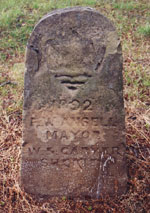
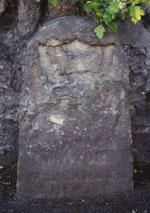
Left This stone marking the new 1889 boundary was set up in Cuckoo Lane (in the section that is now Woodlands Road) in 1892, in the mayoralty of F. W. Axtell and the shrievalty of W. S. Carter.
Right This stone on London Road opposite Headley Way is now illegible, but probably dates from the same period, as it marks the same boundary line.
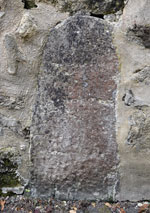
Left: Stone set in the wall of Cuckoo Lane, near Headington Hill Hall
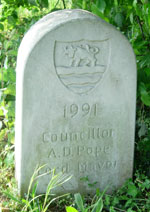
Right: Oxford’s administrative boundaries were most recently extended in 1991. This stone near the Thornhill Park & Ride was set up that year in the mayoralty of Alan Pope, and is the only stone in Headington that marks a boundary that is still in existence.

Headington mounting stones
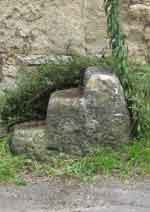
Left: A mounting stone in the Croft in Old Headington, at the back of the White Hart
Right: A mounting stone in Old Road, on the way up to Shotover. This was erected by Dr Bracegirdle “out of good intent to ease passengers there to mount their horses”. The stone was moved here when the Eastern Bypass was built
This is presumably Roger Bracegirdle, a late Fellow of Brasenose College and a physician of Oxford whose will was proved on 16 May 1610. and Bracegirdle Road in Wood Farm is named after him.
There is another stone near the top of Shotover where people could climb back into the coach to London and another in Wheatley which they could use to dismount when Shotover Hill was approached from the opposite direction.
