


The Priory (Linden House), Old High Street

This photograph shows the Priory in Old High Street from the back. Until 1923 the building was known as Linden House.
Linden House was the largest property held by copyhold under the Manor of Heddington, and parts of it are believed to date from Elizabethan times, although it was drastically altered in the Victorian period. In the two pictures below it can be seen as it was in about 1905 when it was still a private house. The three adjoining small dwellings to the north are Linden Cottages, which were demolished and replaced by the present two Linden Cottages in 1908.
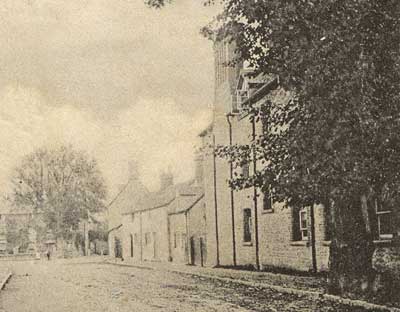

The Headington rent book shows that in 1850 Linden House was owned by George Baker Ballachey of Bury Knowle House. Ballachey’s wife Maria was the daughter of Sir Joseph Lock, who built Bury Knowle House, and Linden House may have been in her family since the time of the Headington Enclosure Award of 1804. In 1850 its rateable value was £26 and its gross estimated rental was £32-10-0.
William Henry Butler (an Oxford wine merchant and Mayor of Oxford in 1836/7) retired to Headington (where his brother was already renting the Manor House), and the 1841 census shows him living in Linden House (which he rented from George Baker Ballachey) with his wife Elizabeth and their children Edwin, Lucy, and Mary, and two servants. His wife died there in 1844 at the age of 55. In the 1851 census he is still shown as a widower at Linden House with two of his children, but he moved to Hanborough in about 1854.
Linden House School: 1858 to 1864
The Priory was bought by William Richard Hurst, and he largely rebuilt it and ran a school there for six years, with Linden Cottages used as boarding houses and classrooms: for more details see Linden House School.
On 16 July 1864 Hurst advertised that in the ensuing term he planned to move the school to extensive premises at Littlemore, and on 13 August 1864 he advertised that Linden Hose was to let:
HEADINGTON. TO be LET, at Michaelmas next,—LINDEN HOUSE, containing ten rooms, and having attached to it flower and kitchen garden, lawn and shrubbery, stable, coach-house, and paddock (one acre in extent.)
Also at the same time, the BUILDINGS occupied as a School House.
Application, in the first instance, by letter only, to be made to Mr. W. R. Hurst, Linden House, Headington.
Private house: 1865 to 1923
By 1866 Linden House was a private house again, shown in the Oxford Directory for that year as being occupied by Mrs Lovell. Jackson’s Oxford Journal for 2 June 1866 reports on a case at Oxford County Court on 25 May 1866 where Miss Maria Clementine Lovell was awarded £31 10s. damages from Mrs Maria Ballachey (her neighbour at Bury Knowle House) when she was bitten by Mrs Ballachey’s dog, a retriever called Rover.
On 13 June 1868 it was advertised thus as being to let: “LINDEN HOUSE, with Garden, Stable, and Coach House, at Headington. Rent, 342.”
From 1868 to 1874 Linden House appears to have been occupied by Henry Franklin, described in the 1871 census as “Teacher (Preparatory School for Harrow, Eton, &c.)”, and his wife and seven children. There are no boarders in the house, and it seems likely that Franklin (who had been the Master of Headington National School until the end of 1867) taught at the Rookery School, which opened in 1861. This suggests that the Revd John William Augustus Taylor, founder of the Rookery School, may have been the buyer of Linden House School in 1864.
Linden House is listed in directories from 1875 as occupied by John Treeve Edgecombe. He died there at the age of 66 on 19 March 1881, and the census taken shortly afterwards shows his widow Jane Edgecombe (56), described as an annuitant, living there with another widow of the same age as her boarder, and two servants. She moved to Church House in St Andrew’s Road shortly afterwards.
Major-General (later Colonel) John Desborough, Governor of the Military College, then extensively rebuilt the house, and (according to Within Living Memory) stayed at Headington Lodge (now White and Sandy Lodge) while the work was being undertaken. The Oxford Chronicle for 11 October 1884 (p. 7f): reported “At Headington a large old fashioned residence has been remodelled as a residence for Major-Gen. Desborough, from the designs of Mr. H. G. W. Drinkwater, architect.” Despite all the work that Desborough had done, it appears that he only lived in Linden House for four years, from 1884 to 1888.
The following advertisement in Jackson's Oxford Journal of 9 June 1888 of the forthcoming auction of Linden House describes the internal layout and outbuildings:

On 23 March 1889 the forthcoming auction of the furniture of Linden House was advertised in Jackson's Oxford Journal:
LINDEN HOUSE, OLD HEADINGTON, OXON.
UPWARDS OF 100 LOTS OF USEFUL HOUSEHOLD FURNITURE,
Consisting of Chests of Drawers, Toilet Tables and Wash Stands, Chairs, Iron Bedsteads and Bedding, Hanging Press, handsome Chimney Glass & Mirrors in gilt frames; sets of Lawn Tennis, Croquet, & Bowls; Patent Mangle, Pony Trap and Harness; Saddles and Bridles, Iron Garden Roller, two Lawn Mowers by Shanks, two Garden Seats, quantity of Potatoes, Greenhouse Plants, and other Miscellaneous effects
From 1889 to 1891 Captain Algernon G. Scriven wass listed as the occupant of Linden House, and he can be seen here in the 1891 census with his wife and 13-year-old daughter.
From 1895 to 1898 Leonard Fowell was listed as the occupant, and in 1899 only Douglas Garth.
From 1900 to 1921 the house was listed in directories as occupied by Mrs Annabella Sturges, the widow of the Revd Herbert Sturges: the 1901 census shows her as a widow of 41 “living on means” in Linden House in Old High Street with her children Carelia (14), Robert (8), Dorothea (5), Octavius (3), and Guy (1), as well as her cousin and four servants. According to Within Living Memory, she had come from Wheatley, had twelve children in all, and lived to be 93; and rehearsals of amateur dramatics took place in the house, with performances at the nearby British Workman.
By the time of the 1911 census the Sturges family had moved away, though the eldest daughter Carelia Sturges (24) is shown not far away at “Stone House”, a six-roomed house in St Andrew’s Road with three of her siblings and a servant. Meanwhile Maude Effie Mary Eden (46), a married lady with her own means, was living at the 20-roomed Linden House in Old High Street with her daughters Dulcebella (19), Phyllis Eleanor (17), and Betty (14), and four servants. (Carelia Mansfield Sturges married Owen Phibbs of County Sligo in February 1914.)
The 1921 census shows Charles Hardiman Laver (28), a doctor at the Wingfield Orthopaedic Hospital, living at Linden House with his wife Evelyn and their servant.
The Priory of All Saints & All Souls : 1923–1968
In 1923 Linden House was bought by Roman Catholic Dominican Sisters, and these gave the house the new name of “The Priory of All Saints and All Souls”. Theirs was an enclosed order, and a turntable arrangement meant that parcels and food could be delivered without the sisters making contact with the outside world.
The grounds include a cemetery for Dominican nuns, and those buried there include the poet Dorothy I. Little, OP (Sister Mary Benvenuta), who died at the age of 77 and was buried there near the beginning of 1966.
The Priory (1968–present)
In 1968 the building was bought by the Congregation of the Sacred Heart from Barnes in London, who shortened its name to “The Priory”. They were initially involved with teaching in local schools, working in a home for the handicapped, teaching catechism to individual handicapped children, and other parish work.
In the early twenty-first century the Priory, under Sister Marie Ann (who was formerly also deputy head of St Joseph’s Primary School) was principally a hostel with accommodation for 14 students, plus a few rooms for visiting priests and sisters from various parts of the world wishing to study at one of the two universities or language schools of Oxford or use the Bodleian Library. The chapel in the house was open to local people each evening for mass. In addition various groups used it as a meeting place, including Amnesty; the Catholic Handicapped Fellowship; the Baptist, Justice and Peace Group; the Probation Trust; and the Multiple Birth Group. The Quakers also then used the building as a meeting place on Sundays.

The Priory from the Croft in March 2005, when the former Baptist Chapel had just been
demolished and there was an uniterrupted view of the front of the Priory from the west
