Memories of 1 Tintagel Crescent in the 1950s
In mid-1956, just before my fifth birthday, I moved with my parents and younger sister to a brand-new house at 1 Tintagel Crescent (shown in 2022 to the left of the Streetview image below). This was on the Manadon Vale council estate, which is now bisected by the A38 Devon Expressway but was then in the middle of the countryside. The crescent was so called because the streets to the south of the Ham Brook were named after Cornish villages, while those to the north bore the surnames of famous writers.
The estate was so new when we moved in that the roads had not been made up, and the gardens at the front and back were just rough soil, and my father even had to build a concrete path to the clothes line at the back.
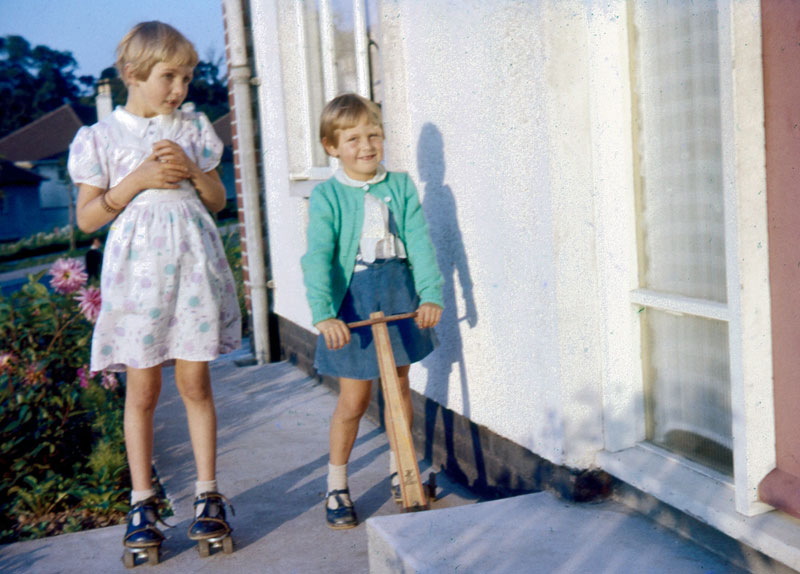
Plymouth Corporation had painted the doors of 1, 3, 5, & 7 Tintagel Crescent respectively red, blue, green, and yellow. The photograph below taken in about 1958 shows me on roller skates with my sister on a wooden scooter near the red door of No. 1.
This was a huge improvement on our previous accommodation, which had been just the ground floor of a requisitioned house at 20 Salisbury Terrace on the Milehouse Road: another family with six children lived upstairs and therefore had the bathroom, so our mother had to heat water in a copper and fill a tin bath. Hence having hot running water for the first time (from an immersion heater in summer or heated by the coal fire in winter) seemed like magic.
The new estate had no bus service, and buses didn't even serve Honicknowle Lane, which was still a narrow country lane. The grocer's shop for the estate in St Pancras Avenue run by Mr Smith was small and expensive, so my mother used to walk up to Peverell Corner to get food shopping in the Co-op there and visit the Post Office, or sometimes took the bus from Peverell Corner into town, carrying an enormous heavy travelling bag.
For children it was a marvellous place to live. Opposite our house was a little playground with swings, a seesaw, concrete tunnels, and a semicircle of bars. As we got older we climbed up to the top of the swings, gave each other the bumps on the seesaw, and hung upside down from the bars or walked vertically over them, not in the least worried about the concrete below us.
The red telephone kiosk at Tintagel Crescent (across the road from No. 7) often had a queue of people outside it, as hardly anyone had a phone in their house. When it was empty it was always worth going in and pushing Button B in case anyone who had failed to get through had forgotten to get their 4d. refunded.
We also had the benefits of living on the edge of the countryside. At the north edge of the playground was what we called the stream: no one called it the Ham Brook. We used to walk through the water and tried to make things out of the clay we found, but of course it never set, as we had no means of firing it. To the east, before reaching the Golden Hind pub, there were bluebell woods, and we used to gather armfuls of bluebells for our mother, taking care not to pull them up by the roots. Once when we were a bit older we children walked along the narrow Linketty Lane and visited what was then the rural village of Egg Buckland. To the north-west over the Ham Brook there were fields with cows as far as Chaucer Way. One night the cows escaped and walked through our gardens, leaving enormous hoof prints.
At the back was a very steep hill, as yet with no buildings. This was abundant with blackberry bushes and wild flowers such as lady's smock. We children made dens in the hedges here, putting old pieces of carpet on the ground.
Most of the children at the south end of Manadon Vale attended Pennycross Primary School rather than Manadon Vale Primary School. The children of Tintagel Crescent marched on their own in an army from Tintagel Crescent to school, crossing Honicknowle Lane without help (the official school crossing with a lollipop man was near the top). We proceeded to Arden Grove via Springhill and Melrose Avenue, and were sometimes tempted to enter the sweet shop where the latter two roads met to buy liquorice bootlaces, sherbert fountains,or “sea food”, or loose items such aniseed balls that were sold by the ounce and weighed in an old-fashioned set of scales. The journey was only a distance of half a mile, but for the many children such as ourselves who came home at lunchtime, it meant that we walked two miles a day. Unrestricted by parents, on the way to school we climbed up and down this set of steps outside the handrail. It is good to see in that image that the oak tree where we used to gather fallen acorns for the school nature table is still nearby. We also used to make slides on the pavement when it was icy.
We children knew the name of almost all the children at our end of Tintagel Crescent and the nearby part of St Pancras Avenue, and had many friends. Sadly once my sister and I passed the scholarship for grammar school, we no longer saw much of our old friends and stopped playing in the street. Of the forty or fifty children in my class, I was the only one from the estate who won a place at Plymouth High School.
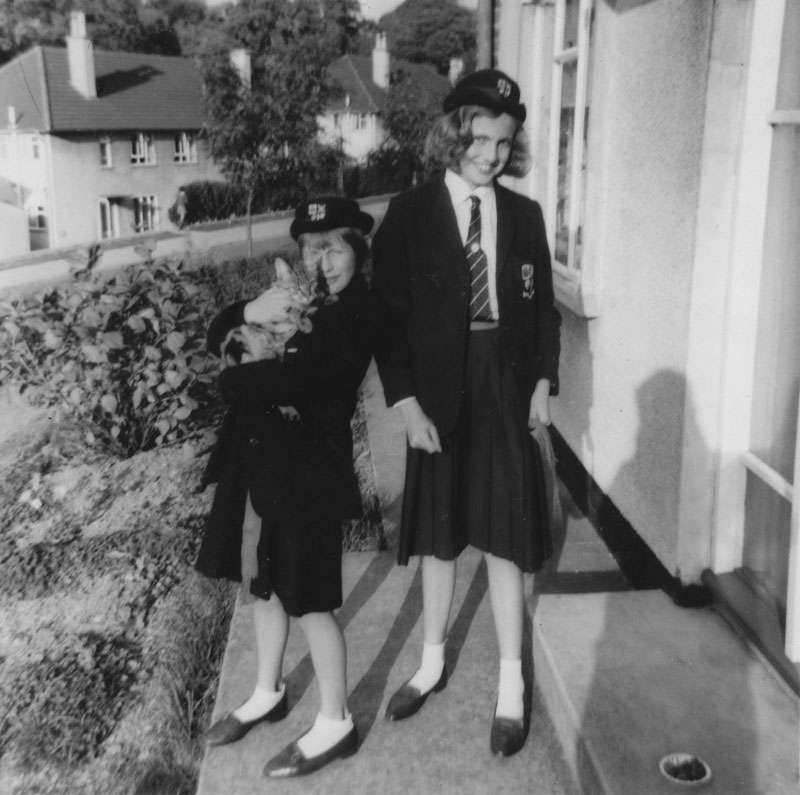 My sister and I ready to go back to school in September 1964. For my sister (10¾) this was the
first term at Plymouth High School for Girls and for me (just 13) the start of the third year.
We are both sporting the obligatory tricorn hats and red Temple House girdles
I think that the rent for our house was £2 10s a week when my father's income was £20 a week. The Corporation was extremely strict with its tenants and made regular inspections: my father was made to take down the small fence he had erected to the east of No. 1 and replace it with a hedge, and to get rid of a piece of corrugated roofing he had put up over the back yard to keep his bicycle dry.
There were two rooms downstairs: a large sitting/dining room, and a very small kitchen, with a hatch between the two. There was also a narrow indoor passage down the right-hand side of the house with a large coal bunker on the right: this led from our side door at the front to our back door leading into the garden, and if both these doors were accidentally opened at the same time when it was windy, one usually slammed, breaking the glass, and my father had to fix it. Upstairs there was the bathroom at the back right, a large bedroom on the left running from the front to the back of the house with a window each side, and a smaller bedroom on the right with one window at the front containing the immersion heater in an airing cupboard.
No one ate in the kitchen then, so the fact that ours was tiny didn't matter, especially as we didn't have the electric appliances that people have today such as a fridge, freezer, washing machine, or dishwasher. The kettle was boiled on the gas cooker, and when we did eventually get a refrigerator, it was a gas one. The rooms only had one electric socket each, which initially was more than enough as in the whole house we only the only socket we used was for the radio, but this became inadequate as more electrical items became common.
Electricity was expensive, so most people heated their homes with a coal fire or paraffin heater. Our living room suffered from bad condensation in winter, as every gallon of paraffin burnt there produced one gallon of water that streamed down the walls of our living room. At least it was warm in winter; the rest of the house was freezing, often with ice on the inside of the bedroom windows in the morning, and I always had chilblains.
I am not sure whether anyone had a washing machine: everything (including sheets) was generally washed by hand, except for towels and tea towels, which were boiled in a metal bucket on the gas stove. It was a great improvement when my mother got a mangle. Most people had a pair of washing lines, one above the other between two poles, with a cleat and rope at one side enabling the sheets to be hoisted up high. There was no room to hang washing indoors, and in winter it often froze solid on the line.
We had just one metal dustbin, and the binman had to climb the steps and heave it on to his shoulder, bringing it back again afterwards. Although there was no recycling then, it was plenty big enough, as we didn't throw away bottles but returned to retrieve a deposit, and there was no plastic packaging or processed food, and newspaper was retained for lighting fires. Everything was cooked from basic ingredients, and nothing was wasted, although of course we had a compost heap for peelings.
Very few people on the estate had cars, and those that did parked them in the garages behind our house: in those days no one would have left their car or van on the street overnight. A couple of families had motorbikes and sidecars, but most people walked everywhere.
We had a huge garden at the back, where my father grew all our vegetables. All the houses had pretty gardens in the front, despite their steepness.
The milkman came early every morning, including Sundays, with pint bottles of milk made of glass, and there were many other regular callers. Not many women on the estate worked, so were able to shop from the Co-op bread van which delivered every day, and the Corona lemonade lorry every Wednesday (taking back the empty bottles from the previous week and paying back the deposits). The rag-and-bone man regularly pushed his cart though the estate, using scales that had a hook for weighing items so he could judge how much to pay: he called out something that sounded like “Arney Bowg”, which was probably meant to be “Any old rags and bones?”. Our coal was delivered by lorry, and we children were sent out to count the number of sacks being brought in to make sure that we received all twenty sacks paid for. Similarly when the chimney sweep came, we were sent out to make sure that the brush came out of the pots at the top. A man came every quarter to collect the shillings from the gas meter, and he was very welcome, as he always gave a rebate. The Forester's insurance man visited many homes on a Friday evening to collect subscriptions, and door-to-door salesmen often called with their suitcases, as well as Jehovah's Witnesses. The rent man came once a week and was paid in cash: cheque books were very rare then, and bank cards non-existent.
On summer evenings and at weekends, children went out to play on the triangle in front of Nos 1–7 Tintagel Crescent, with the girls playing organized games such as “Fairies and giants" or "What's the time Mr Wolf?”. We also played skipping games, and later my sister did French skipping here, but I was too old for that development. When the hula-hoop craze started in the late 1950s, they were used here. The boys were wilder, firing guns with caps, racing home made go-karts down the slope to the postbox or knocking on doors and running away. If residents complained about them running through their front gardens, they received the response, "Its not yours: it belongs to the Corporation". Games such as Hide & Seek that needed more room were played in the playground opposite and the adjoining fields. When we were a bit older, we played tennis in the middle of St Pancras Avenue, as we rarely saw a car. Dogs were let out loose on the streets for their walks (making dog's mess a regular hazard): we would sometimes tie a rope around their collars and pretend that they were ours. My sister and I did not have bicycles, but learnt to ride on the road outside our house on those belonging to other people. We raced around the estate on roller skates, though.
The houses on the north side of Tintagel Crescent were built some years after we moved in: originally it was a piece of waste land, where each year on Guy Fawkes' Day the older boys built a huge bonfire and everyone joined in.
When we first moved in we were sometimes invited into other people's houses to watch television, but we started to rent our own in 1958. The service from Rediffusion was poor and frequently broke down, and initially we could only get the BBC, as the nearest transmitter was in south Wales. The television didn't operate during the day, and we had the Home Service on the radio playing most of the day.
There was some extreme poverty: sometimes neighbours would call on a Wednesday (the day before pay day) with a cup begging for it to be filled with sugar. Despite this, I don't remember any burglary on the estate, and when if we were out playing when my mother went shopping, she used to leave the small upper window at the front of the house open so that if we wanted to come in we could climb on the window ledge, put our arm through, and opened the latch of the side window to get in.
I knew nothing of our local church, St Pancras, and wasn't even aware that we lived in its parish: we like many people I knew attended Pennycross Methodist Church. Pounds Library did not exist at this time, so our nearest library was at North Prospect, and we read so many books we walked the 1.3 miles each way at least twice a week, cutting through allotments off Ham Drive that smelt strongly of the piles of chimney soot that the gardeners used there.
It was a big day when Honicknowle Lane was widened and the No. 19 bus from Tamerton Foliot came that way for the first time: henceforth we only had to walk to the end of the footpath at the end of Boscastle Gardens to get the bus to town.
Looking at the map today, there are so many changes. What happened to the riding stables near the bottom of Honicknowle Lane, and the stock-car racing track near the top?
Stephanie Verhoeven
November 2022
Remembering Ann, Bernice, Denise, Jacqueline, Lesley,
Linda, Marilyn, Shirley, Sharman, Susan, Valerie,
Veronica,
and all the other girls who lived nearby in the 1950s