


Magdalen (or Workhouse) Quarry, later Corporation Pit

This disused one-acre stone pit is very near the west side of Gladstone Road but quite hard to find. Just to the south of Headington Community Centre go into William Kimber Crescent, and take the lane to the left leading to the Scout Hut: the entrance is to the right of that hut: map
This pit originally belonged to Magdalen College, and there is some evidence of its use by Magdalen College from 1474 and Wadham College from 1610.
- Stone in Archaeology Database: Magdalen Quarry, Headington
- Oxford Geology Trust leaflet on Magdalen (Workhouse) Quarry
- Site of Special Scientific Interest: Magdalen Quarry
The maps below all show the proximity of the Headington Union Workhouse, explaining why in the nineteenth century it was often known as the Workhouse Pit. According to Raphael Samuel in Village Life and Labour, it was called the Corporation Pit, and it was said, “you didn't need a Union card to get into the pit, you needed a name – Gurl”. It was the last working quarry in Headington, only closing in 1949. It still belongs to Oxford City Council.
|
|
|
|
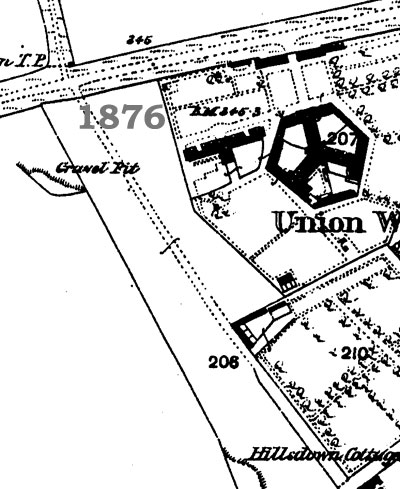
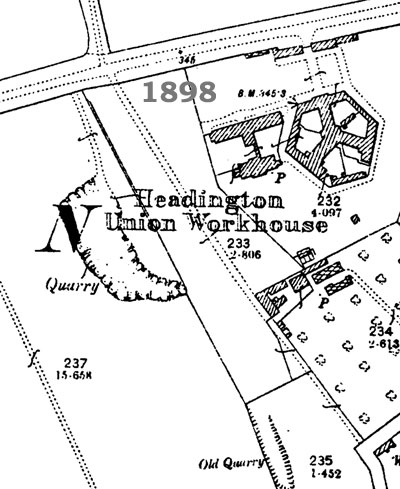
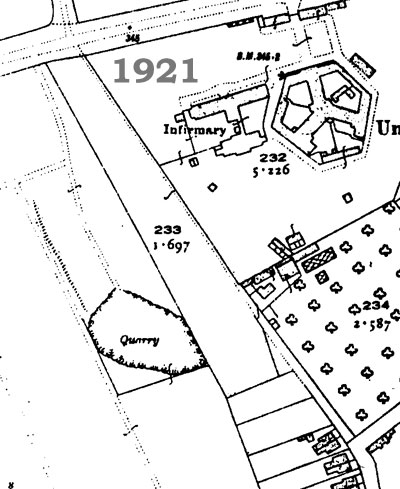
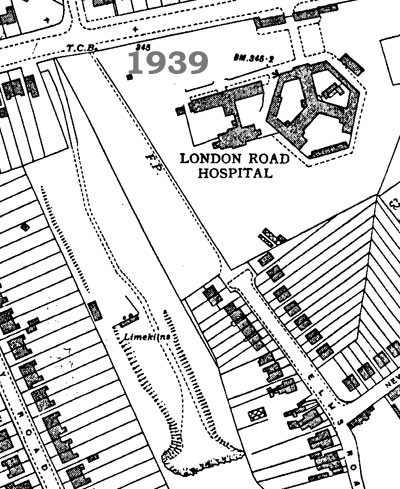
As the above maps show, quarries were not fixed workings restricted to a single rock face, but progressed onwards over the years.
At a meeting of Oxford City Council held on 7 June 1899 its General Purposes Committee recommended that “the Corporation take from Magdalen College the stone quarry at Headington recently worked by Mr. Franklin for the purpose of obtaining stone for use of the roads in the City”. A report of the YMCA Rambling Club published in Jackson’s Oxford Journal on 24 June 1800 confirms that the council were then renting this pit from the college for that purpose, and describes the coral fossils there:
The third halting place was the stone quarry just rented from Magdalen College by the Corporation for road-making purposes, situated just off the main road under the West wall of Headington Workhouse, and where the two divisions of coral rag, the lower division of calcareous grit, and upper one of coral rag proper, are well seen. The quarry was soon alive with fossil hunters, and specimens of the Thecosmilia, the Isastrea, and other corals and shells were brought to Mr. Bell [the President of the Oxford Natural History Society] for explanation, he pointing out how very different our climate must have been for corals, the inhabitants now of the tropical Pacific Ocean, to have lived here in past ages before the Thames and Cherwell rivers had carved out the present deep valley between Shotover and Cumnor hills.
This quarry is now a Nature Reserve and Site of Special Scientific Interest. The rocks exposed in the cliff face are of Upper Jurassic age, deposited c.140–150 million years ago. The upper rocks are Wheatley limestone, with some bands of smooth limestone called Headington Hardstone running through it: this is the stone used for important Oxford buildings. In the middle are shell pebble beds, and the lower rocks are Beckley sand.

Left: Fossil found at Magdalen Quarry. Whole fossils like this are quite rare here (unlike at Rock Edge), and fragments of shell ware are more common.
The photographs on this page were all taken on Saturday 23 July 2011 when the Oxfordshire Geology Trust held an open afternoon at this quarry.

The preferred layers of stone here were known by stonemasons as the 1st, 2nd, or 3rd “Headington Hard”, and the “Hedgehog Course”.

