


William Matthison (1853–1926)
William Matthison was a watercolourist, many of whose pictures were made into chocolate-box-style postcards. He lived in Headington from 1915 until his death in 1926, and his widow remained there until 1939. They are both buried in Headington Cemetery.
William was born in Harborne (a parish that was later transferred from Staffordshire to Warwickshire and is now part of Birmingham) in 1853. Although it is stated on his gravestone that he was born in 1853, the only child of that name registered in the Kings Norton district was born near the end of 1854. When he was married in 1875 he stated that he was the son of William Matthison, which means that he could be the baby called William Matheson, son of William and Mary, who was baptised at Harborne on 5 November 1854, and that the William Matthison (21) of Latimer Street who married Mary Sefton (27) at St Thomas's Church in Birmingham on 2 October 1852 were his parents.
There is a mystery about his birth however, as on 1 September 1856 at the parish church in Edgbaston, Birmingham, David Sumner, a man who was to describe himself as William's stepfather, married Mary Matthison, who was described as a spinster.
At the time of the 1861 census William Matthison (6) was living in Ladywood, Birmingham with David Sumner (29), who was born in Westbury, Wiltshire and described as a silver pickler, and Mary Sumner née Matthison (34), who was born in Wood Green, Worcestershire, plus their two young daughters Mary Ann Sumner (3) and Eliza Sumner (eleven months).
William attended King Edward’s School in Birmingham, and at the age of 15 he took evening classes in advanced drawing at Birmingham’s Central School of Art and then became a pupil of the Birmingham artist Edward Watson.
In the 1871 census William (16) was again stated to be the stepson of David Sumner and appears to be described as a “Sadler”. He was living at 7 Triston Street, Birmingham with David Sumner (39), who was now described as a fruiterer and watchman, Mary (46), and their daughter Mary Ann Sumner (13).
In 1875 Matthison became a professional artist. He spent the summer of 1877 sketching in south Warwickshire, and settled in the village of Tysoe. On 6 August 1878 at the parish church there, William Matthison (24), described as an artist, married (Mary) Hannah Fessey (30), the daughter of the labourer William Fessey. They had one child:
- Kate Pauline Matthison (born in Tysoe, Warwickshire on 25 January 1881)
At the time of the 1881 census William Matthison (25), described as a landscape painter, was living in Tysoe, Warwickshire with his wife and their three-month-old baby daughter Kate in the home of his mother-in-law Ann Fessey.
In 1883 the Matthison family moved to Oxfordshire and their first proper home was at Broughton Road in Banbury. He was forced to supplement his income from painting by taking private pupils, but spent his summer holidays painting in other parts of the country, particularly Whitby.
By the time of the 1891 census Matthison was living at 2 Dashwood Terrace, Neithrop, near Banbury with his wife and daughter, plus one servant.
The Daily News of 16 May 1891 reporting on an exhibition of pictures and drawings by members of the 19th Century Art Society at the Conduit Street Galleries, stated that “In the watercolour room Mr. William Matthison shows artistic feeling in some landscape sketches". He exhibited there again in 1892, and also at the Goupil Gallery in New Bond Street, London. Then on 9 February 1893 the Newcastle Daily Journal reporting on the Berwick Club Exhibition, stated that “William Matthison's 'Highland Clachan' (No. 17) depicts a scene of rugged grandeur.” On 15 July 1893 Jackson's Oxford Journal reported:
Among artists resident in this district, none are making more rapid headway than Mr. William Matthison, of Banbury, whose water-colour landscapes have attracted considerable attention at the Royal British Artists' and other important exhibitions during the past few months.
In 1901 Matthison (47) and his wife and daughter were still living at the same address in Neithrop; he described himself as a professional artist, and the family employed a servant. Although Matthison was able to sell his work directly from his studio there, he was having to travel to Oxford three or four times a week to give lessons.
In 1902 Matthison moved with his family to Park Town in Oxford. The picture postcard industry was just beginning, and Matthison was commissioned by Robert Peel to paint over 70 views of the University and City of Oxford. The cards were sold exclusively by E. Cross of Pembroke Street, Oxford at seven for a shilling. He was also commissioned to paint scenes of the Lake District, Whitby, and Looe, and painted scenes of London and Cambridge for postcards produced by Raphael Tuck & Sons.
In about 1905 Matthison was commissioned by Salter Brothers of Folly Bridge to produce a set of six postcards depicting their steamers on their route from Oxford to Kingston-upon-Thames, namely the Oxford, Nuneham, Henley, Windsor, Reading, and Kingston, each passing through the place after which it was named.
In 1907 Matthison was commissioned to paint a view of Oxford’s High Street for the front cover of the souvenir guide of Oxford’s Historical Pageant.
The reviews of of M. A. R. Tuker's book Cambridge (A. & C. Black, 1907) praised the illustrations by Matthison:
Daily Telegraph (22 May 1907):
Mr. William Matthison's pictures, of which there is a goodly array of more than seventy-five, display an average talent brightly employed. There is, as a matter of fact, too much colour, and a tendency to scamp details, but the various pictures contrive, nevertheless, to give faithful impressions of familiar scenes.
The Scotsman:
Mr. William Matthison's charming coloured illustrations count for much in the volume's attractiveness.... All are painted with a richness and sobriety of colour that accords well with the inner associations of the subject. With both text and pictures so good, the book will take a Cambridge man both by the head and by the heart.
The Globe:
This volume is illustrated delightfully in colour by Mr. William Matthison, whose art has realised and conveyed fully the beauty of the 'Backs,' and of college exteriors and interiors.
By 1910 the postcard boom was coming to an end and Robert Peel gave up postcard publishing. The plates of Matthison’s Oxford postcards were sold to Alden & Co., who continued to sell them and in 1912 published a book entitled Fifty Watercolour Drawings of Oxford, for the most part comprising his pictures.
The 1911 census shows William Matthison (56) and his wife Hannah (63) living in Park Town with their daughter Kate Pauline Matthison (30) who was a private governess, and one general servant. In that year there was an exhibition in Oxford of 95 of Matthison’s paintings, and one reviewer wrote:
Mr Matthison’s work is full of sunshine and colour. Even the rain in St Giles or the High Street does not depress him: he sees it through rose-coloured spectacles, and paints it so we can see it too. His mists are never a hopeless grey, they have a rosy lining.
In 1911 together with the artist Gordon Home he produced the illustrations for a picture book Cambridge in the Beautiful Britain series.
William Matthison was still listed as living in Park Town in Kelly's Directory for 1916/17. but his only child was described as being of Bardwell Road in north Oxford when she was married in 1915:
- On 2 September 1915 at St Andrew's Church in north Oxford, Kate Pauline Matthison (34) married Wilfrid Evans (32), a landscape gardener of the Hardy Plant Nursery, Llanishen, Glamorgan. He was born at Christchurch in Hampshire on 12 June 1883 and was the son of the schoolmaster Josiah Evans.
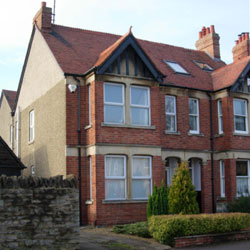
Later in 1915 the Matthisons moved up to Headington to rent the first of two houses in Old High Street (right), which was then numbered 2 High Street, Old Headington but is now 4 Old High Street.
In 1916 Matthison's book Cambridge water-colours was published.
Matthison continued to accept commissions when he lived at Headington, including paintings for Lady Rhondda of Llanwern Park near Newport.
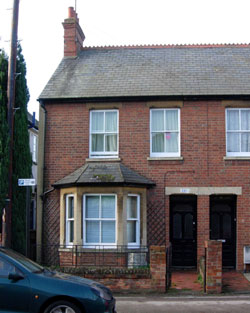
At the end of the First World War Mrs Kate Stone of Headington (who ran a shop in Pitts Road while her husband was away fighting) was left £50, with which she purchased a double building plot in Old High Street, where her husband William Stone built a pair of new houses, now numbered 10 and 12 Old High Street. The Stones moved into the house to the north (No. 10) themselves.
They let the present 12 Old High Street, the house to the south (left), to Matthison, and he is listed here in Kelly’s Directory from 1919. He named the house Park Lea.
(These two houses were originally numbered 10 and 12 High Street, Old Headington, but were renumbered 8A and 10 in the 1930s, and are numbered 12 and 14 Old High Street today.)
The 1921 shows Matthison (67) described as an artist (landscape painter) working on his own account at home and living at 12 Old High Street (then 10 High Street) with his wife Mary (3) and their boarder (a 17-year-old South African girl in full-time education called Marian Daphne McDonald).
On 25 January 1926 Matthison died at the present 12 Old High Street at the age of 71. His funeral was at St Andrew's Church in Headington on 28 January, and he was buried in Headington Cemetery.
His effects came to £3804 19s. 6d., and his executors were his wife and daughter.
This obituary appeared in the Oxford Journal Illustrated on 27 January 1926, p. 11b:
The death of Mr. Matthison
The death of Mr. William Matthison took place at Headington on Monday evening. Mr. Matthison was an artist of no mean repute. He had been for some time Vice-President of the Oxford Arts Society, and he has contributed, during a long professional life-time, to the leading arts societies in the country, showing his skill before he was twenty. After passing into the seventies his hand lost none of its cunning, and his fine studies of trees in his smaller pictures showed that he must indeed have had and retained remarkably good eyesight. Although his pencil drawings are perhaps less well-known to the general public than his vivid watercolours, including many studies of Shotover, he suggested colour by means even of such a medium as the pencil. Before the war he had a large teaching connection and many old pupils up and down the country will be sorry to hear of the death of a charming man, a clever artist, and an admirable master.
His widow Mary Hannah Matthison was still listed at their home at 12 Old High Street in 1933. She died at 58 Stanway Road in Risinghurst on 17 January 1939 at the age of 91 and was buried with her husband four days later. Her effects came to £2,214 9s. 10d., and her executor was her daughter Mrs Kate Pauline Evans (the wife of Wilfrid Evans).

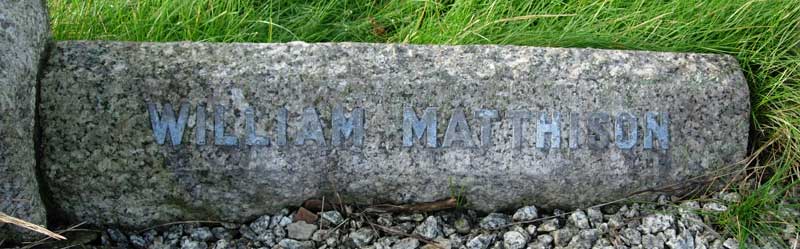
Right: The Matthisons’ grave in Headington Cemetery (Grave 8 in Section C), photographed in 2005. It is a simple grave with lead lettering around the inside of the four edges, some of which has fallen off. It reads as follows:
- WILLIAM MATTHISON
- BORN 1853 – DIED 1926
- MARY HANNAH MATTHISON
- BORN 1847– DIED 1939

Postcards of Oxford signed “W. Matthison”
- Streets and general views High Street and Carfax • The High • Untitled (the High near University College) • The High by Queen’s • Broad Street east • Broad Street middle • Broad Street west • Parks Road • St Mary’s Entry & Brasenose College • St Giles • Oriel Street • Oxford from Headington Hill • Spires of Oxford
- Buildings and monuments • Radcliffe Library, Schools & All Souls • The Martyrs’ Memorial • Balliol College, Martyrs’ Memorial and S. Mary Magdalene Church • War Memorial • The New Schools • Carfax Church from the High • The porch of St Mary the Virgin • Saxon Tower of St Michael’s Church
- The River Summer Eights • The River & barges • The barges, Oxford • Salter’s Oxford and Kingston Steamer (1) leaving Oxford, (2) passing Nuneham, (3) passing Windsor, (4) leaving Henley, and (5) leaving Kingston
- Colleges A–H All Souls College and St Mary’s Church • All Souls College & part of High Street • All Souls College chapel: reredos • Balliol College quad • Balliol College, part of • Brasenose College inner quad • Brasenose College old quad • Corpus Christi quad • Exeter College quad • Exeter College chapel • Hertford College • Jesus College
- Colleges: Christ Church Christ Church • Christ Church and new city buildings • Christ Church Cathedral and refectory from Canon’s garden • Christ Church hall and staircase • Christ Church Tom Quad • Back of Christ Church Hall • Untitled (Christ Church from the Meadow) • Canterbury Gate • The Tom Tower
- Colleges K–N Keble College gate • Lincoln & Exeter Colleges • Lady Margaret Hall • Magdalen Tower & Bridge • Magdalen Tower from Addison’s Walk • Merton Tower & Corpus Gateway • Merton Street • Merton College quad • New College • New College: View from Cloisters • New College: City Wall • New College from Holywell Street
- Colleges O–W Oriel College inside• Oriel College outside • Pembroke College gateway • The Queen’s College • St Edmund Hall • St Edmund Hall, Queen’s, and St Peter’s in the East • St John’s College entrance • Part of St John’s College from garden • St John’s College from the garden • St John’s College gateway • Trinity College chapel • Trinity College gate & chapel • University College • Wadham College • Wadham College from the garden • Worcester College • Worcester College garden: Cottages
Paintings by Matthison in private collections
- Miscellaneous paintings of Oxfordshire Finmere • Finmere Vicarage • Parks Road
Two of his paintings, Fishing Boats in Whitby Harbour (1891–2) and A Halt for the Night are owned by Oxford City Council, and Oxfordshire County Museums Service owns New St Mary's Church, Banbury, Oxfordshire.
An unfashionable artist at the time, prices for Matthison’s work are now rising, according to the Guardian.
Matthison's only child
Kate Pauline Matthison (born 1881) and her husband Wilfrid Evans had two children:
- Mary H. Evans (born in Cardiff in 1916/1917)
- William R. Evans (born in Cardiff in 1918)
At the time of the 1939 Register Kate Pauline Evans was living at a house called “Shotover” in Ty Glas Road, Llanishen, Cardiff with her husband Wilfrid, who was still working as a nurseryman there.
They were living at Homewood, 71A Parkside, Wollaton, Nottingham when her husband Wilfrid Evans died at the St Francis Hospital there on 10 February 1963. His effects came to £3,976 6s., and his widow Kate was his executrix.
Kate Pauline Evans née Matthison was living at 14 Cransley Avenue, Wollaton, Nottingham at the time of her death on 13 August 1980. Her effects came to £11,148.
See also
- Biographical notes by Stephen Penny produced for an exhibition of Matthison's painting and postcards held at the Museum of Oxford in 1985/6
- Document accompanying that exhibition
